Mistral Large 4 is now a download, not just an API. Downloading buys you control over where the model runs, but the license is a modified MIT with a catch for anyone who sells model access, so price the API before you plan any hardware.
The weights landed on 29 October 2026, after a public preview earlier in October. The test scores out so far are real but easy to misread, because the two main sources measure different things.
The short answer
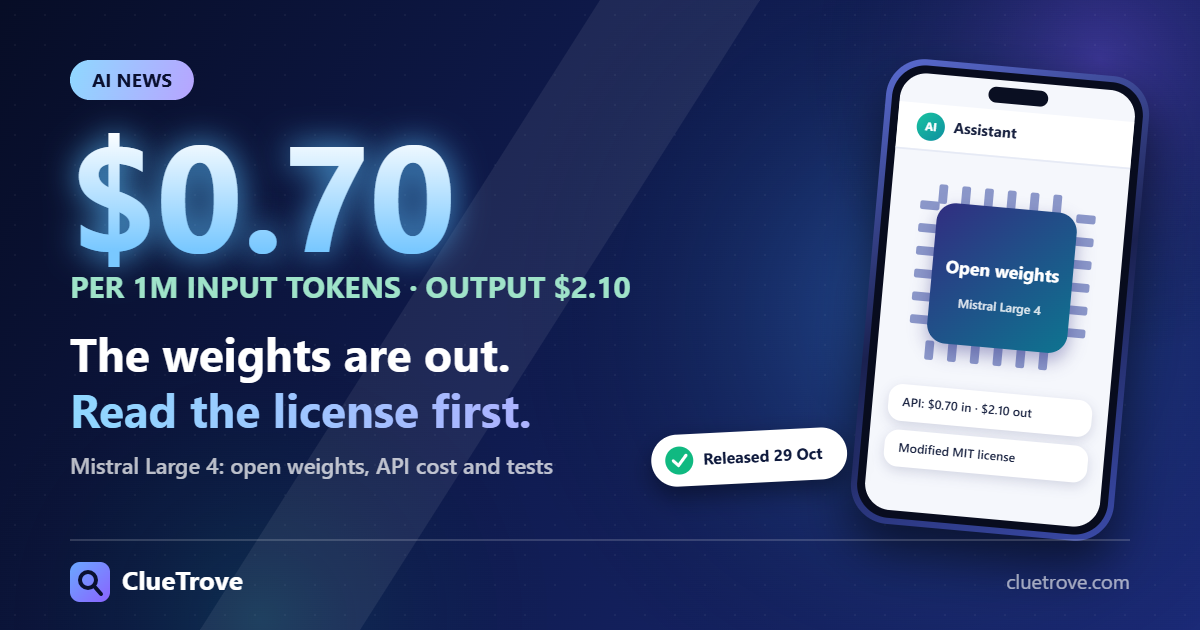
- What changed: the weights are on Hugging Face. Mistral says the model has 1 trillion parameters and is natively multimodal.
- License: the Mistral Ecosystem Open-Weight license, which Mistral calls a modified MIT license. Businesses running a Model-as-a-Service offering need a separate commercial license from Mistral.
- API price: $0.70 per million input tokens, $0.07 per million cached input tokens, $2.10 per million output tokens.
- Tests: Artificial Analysis gives an Intelligence Index of 26 (a score, not a percentage). Vals gives 56.42% on its own index (a percentage). Never compare the two.
What does downloading add compared with the API?
The API gives you the model. The download gives you the model plus control. You choose the hardware, the region, the network and the data path. Nothing leaves your own servers unless you send it out.
That matters for regulated data, offline work and fine-tuning. The license allows use, modification, fine-tuning and commercial use, according to Mistral.
The download does not give you a free ride. You supply the GPUs, the serving software and the people who keep it running. The repository name, Mistral-Large-4-1T-A52B, points to about 52 billion active parameters. Active parameters describe compute per token. They do not tell you how much memory it takes to hold all 1 trillion weights. Plan for the full size.
The API is the fastest start. Mistral lists it on Mistral Studio, OpenRouter, NVIDIA-hosted endpoints and Microsoft Foundry. Artificial Analysis lists a 1.0M-token context window and an output speed of 161.3 tokens per second on its measured endpoint.
What does the license let you do, and where does it stop?
Do not call this plain MIT. The file adds one condition. If you or an affiliate run a Model-as-a-Service business, you must sign a separate commercial license with Mistral before using the model or its derivatives commercially.
The file defines Model-as-a-Service as giving a third party inference or post-training access, such as through an API or hosted endpoint, where that party gains meaningful control over inputs, parameters or training data. Two things are carved out of that definition: building the model into an end-user product, and simply relaying requests to models hosted by others.
The commercial-license requirement also does not apply to internal use, meaning the model and its derivatives are not made available to third parties. It does not apply to use through Mistral’s official products either. The file states no revenue threshold. Copies must keep the copyright and permission notice, and the model and its output come with no warranty.
In practice, a company using the model inside its own tools sits on the free side. A company reselling hosted access sits on the paid side. Cases in between depend on the exact wording. This is not legal advice. Have counsel read the file before you build a product on it.
What does it cost through the API?
| Per million tokens | Price |
|---|---|
| Input | $0.70 |
| Cached input | $0.07 |
| Output | $2.10 |
Both Mistral and Artificial Analysis list the $0.70 and $2.10 prices. Here is a worked example. This is our arithmetic from the table, not a measured bill.
Say a job sends 10 million input tokens and gets 2 million output tokens. Input costs $7.00 and output costs $4.20, so the job costs $11.20. If 8 million of those input tokens are cached, the cost is $0.56 for cached input, $1.40 for the 2 million fresh input tokens and $4.20 for output. That totals $6.16.
Self-hosting has no per-token bill, but it has a server bill. Compare your monthly GPU cost with what the same traffic would cost at these prices. Token price alone can also mislead, because a model that writes more tokens costs more per job. See why a cheaper AI model can cost more per finished task.
How do you read the independent test results?
| Source | Measure | Result |
|---|---|---|
| Artificial Analysis | Intelligence Index, reasoning high | 26 (index points) |
| Artificial Analysis | Cost per Intelligence Index task | $2.06 |
| Vals | Vals Index | 56.42% (±1.26) |
| Vals | Vibe Code Bench v1.1 | 81.56% (±3.29) |
| Vals | Terminal-Bench 4.0 | 26.26% (±5.13) |
The 26 is a combined score on Artificial Analysis’s own scale. The Vals numbers are percentages on Vals’s own tasks. Different tests, different scales. A 26 is not “26%,” and 56.42% is not a better or worse version of 26.
The ± figures are the uncertainty Vals reports. Terminal-Bench 4.0 at 26.26% ± 5.13 could plausibly sit anywhere from about 21% to 31% (our arithmetic). Treat close scores as ties.
Setup matters too. Vals lists temperature 1, top-p 0.95 and a 256,000-token output limit. Mistral’s post shows 41% on Terminal-Bench 4.0 in a chart titled Artificial Analysis Coding Agent Index, with no harness or settings given. Vals reports 26.26% under its own setup. Do not read the gap as an error by either side.
Mistral calls it the best open-weight model for coding. That is Mistral’s claim, tied to the benchmarks it chose. Check it against your own code. For more on this trap, see five ways AI benchmark tables mislead.
Who should care, and who can skip
- Care: teams with data that cannot leave their own infrastructure, and teams that want to fine-tune. The download fits those needs; a hosted API does not.
- Care: anyone building a hosted service on the model. The Model-as-a-Service condition applies to you.
- Skip for now: small teams with light usage. At $0.70 and $2.10 per million tokens, the API is the simpler first step. Price your own GPUs before you assume self-hosting is cheaper.
- Skip: anyone who only wants a chat app. The weights change nothing for you.
What to do next
- We suggest starting with the API on a sample of your real tasks. Measure cost per finished task, not cost per token.
- We suggest reading the license file yourself, then asking counsel if you plan to offer the model to customers.
- We suggest pricing self-hosting only after the API trial shows the model fits your work.
- We suggest ignoring any single ranking. Use the table above to see which test each number belongs to.
Questions and answers
Is Mistral Large 4 under the MIT license?
Not plainly. It uses the Mistral Ecosystem Open-Weight license, a modified MIT license. Model-as-a-Service businesses need a separate commercial license from Mistral.
Can my company use it internally for free?
Yes, under the file’s terms. The commercial-license requirement does not apply to internal use that does not make the model available to third parties. Have counsel confirm your case.
What does the API cost?
$0.70 per million input tokens, $0.07 per million cached input tokens and $2.10 per million output tokens, according to Mistral.
Is a score of 26 worse than 56.42%?
No comparison is possible. 26 is an Artificial Analysis index score. 56.42% is a Vals Index percentage. They use different tests and scales.
Is it the best open model for coding?
That is Mistral’s claim. Independent scores exist, but they use different tests and settings. Test on your own code before you rely on it.
Terms in plain language
- Open weights: the trained model files are public to download. This is not the same as open source, because the license sets conditions.
- Model-as-a-Service: selling other parties inference or post-training access to a model, as the license file defines it.
- Active parameters: the part of the model used for each token. It does not set the memory needed to store the model.
- Cached input: text the provider has seen recently and charges less to read again.
Sources
- Mistral: Mistral Large 4 open weights announcement
- Hugging Face: Mistral Large 4 LICENSE file
- Artificial Analysis: Mistral Large 4
- Vals AI: Mistral Large 4 OSS
Facts read on 31 October 2026.
Part of the guide: AI model pricing and API cost guide.