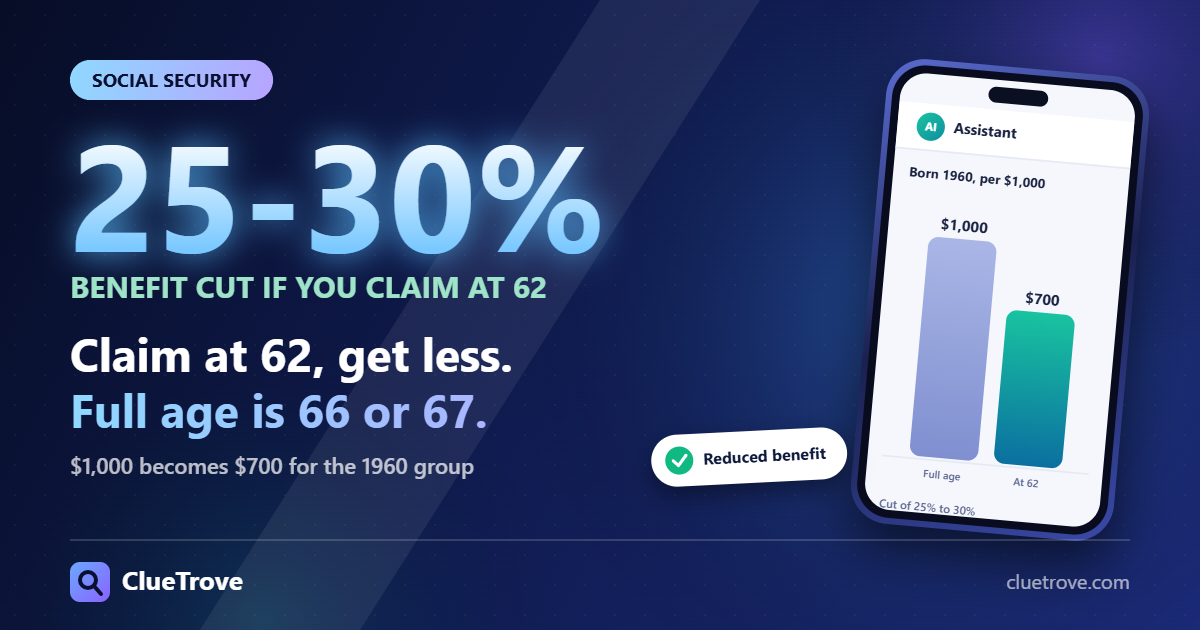
Your full retirement age is 66 if you were born 1943 to 1954 and 67 if you were born in 1960 or later. Claim at 62 and your benefit shrinks by 25% to 30%, so a $1,000 benefit becomes $700 for the 1960 group.
The short answer
- Range: SSA says full retirement age “varies from age 65 to age 67 by year of birth.”
- 1943 to 1954: 66. From 1955 it rises two months a year, reaching 66 and 10 months for 1959.
- 1960 or later: 67.
- Earliest start: 62, with a reduction for each month before full retirement age.
- Cost of claiming at 62 if born 1960 or later: 30% less, for a worker. A spouse’s benefit is cut 35%.
What is your full retirement age?
| Year of birth | Full retirement age | Reduction if claimed at 62 (worker) |
|---|---|---|
| 1943 to 1954 | 66 | 25.00% |
| 1955 | 66 and 2 months | 25.83% |
| 1956 | 66 and 4 months | 26.67% |
| 1957 | 66 and 6 months | 27.50% |
| 1958 | 66 and 8 months | 28.33% |
| 1959 | 66 and 10 months | 29.17% |
| 1960 or later | 67 | 30.00% |
SSA’s full table goes further back. Full retirement age is 65 for people born in 1937 or earlier, then rises two months per birth year, from 65 and 2 months for 1938 up to 65 and 10 months for 1942. People born on January 1 use the previous year’s full retirement age.
For widows and widowers whose entitlement is based on age 60, SSA adds two years to the birth year when it works out the early-retirement reduction.
What happens if you claim at 62?
You can start retirement benefits as early as age 62, but you are entitled to full benefits only at full retirement age. Start early and your benefit is reduced a small percentage for each month before that age. You must be at least 62 for the entire month to receive benefits.
Take a worker born in 1960 or later. Claiming at 62 means 60 months early and a 30% reduction, so a $1,000 benefit becomes $700. A spouse’s benefit is reduced by 35% in the same situation. SSA notes the percentages are approximate because of rounding.
How do the reductions compare across birth years?
The later you were born, the bigger the hit for claiming at 62. Someone born in 1954 gives up 25.00%, a quarter of the benefit. Someone born in 1959 gives up 29.17% and someone born in 1960 or later gives up 30.00%. The gap between the first and last group is five percentage points, because the full retirement age moved up by a year while the earliest start stayed at 62.
Each step in the table adds two months to full retirement age. Each step also adds a little to the reduction. If you were born in 1957, check your own row: 66 and 6 months and 27.50%.
Does waiting past full retirement age help?
Yes. Delaying past full retirement age, up to age 70, increases your benefit through delayed retirement credits. If you are already at full retirement age, you can also pause payments to earn more, by pausing your benefit.
What should you do next?
- Find your full retirement age in the table above.
- Create or sign in to a my Social Security account to see your own estimates.
- Use SSA’s planning tools to compare ages before you pick a start date.
Common mistake: assuming full retirement age is 67 for everyone. It is 67 only for people born in 1960 or later. This is general information, not financial advice, and it does not tell you when to claim.
Questions and answers
Is full retirement age 67 for everyone?
No. It is 67 only for people born in 1960 or later. For 1943 to 1954 it is 66.
Can I get retirement benefits before 62?
No. Retirement benefits start as early as 62.
What is my reduction if I claim at 62?
It depends on your birth year: 25.00% for 1943 to 1954, rising to 30.00% for 1960 or later. A worker born in 1960 or later gets $700 from a $1,000 benefit.
What is full retirement age for someone born in 1958?
66 and 8 months. Claiming at 62 reduces the worker’s benefit by 28.33%.
How high can waiting raise my benefit?
Delayed retirement credits keep adding to your benefit until age 70.
Sources
Facts last checked on 20 October 2026.