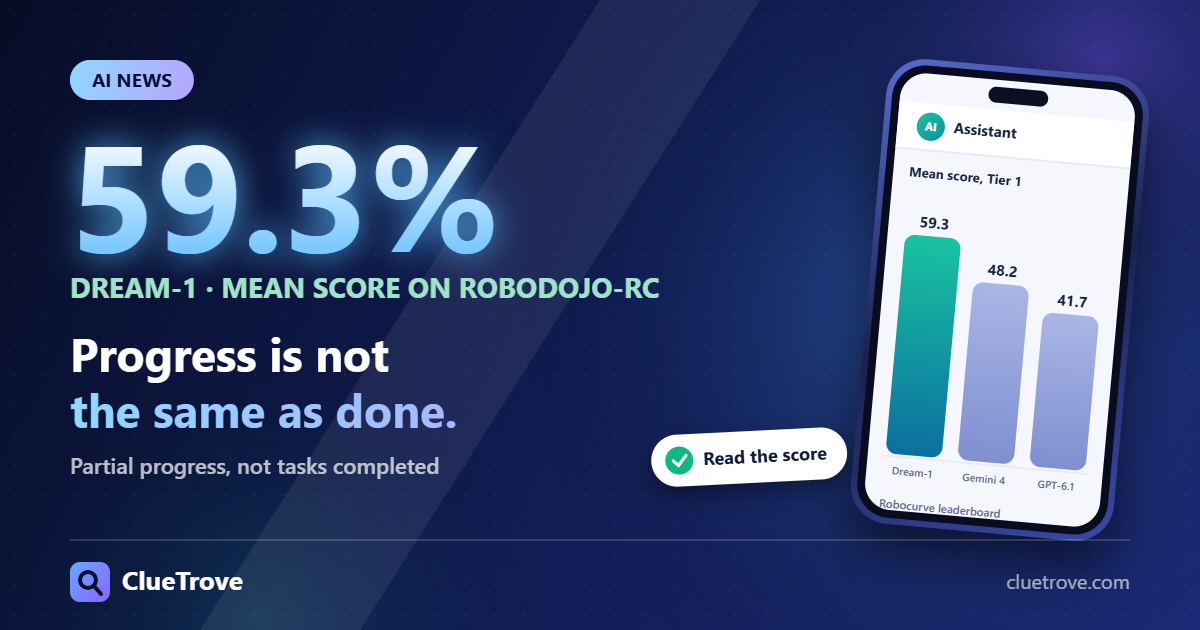
Robocurve’s leaderboard puts Dream-1 at a 59.3% mean score on RoboDojo-RC Tier 1, ahead of 48.2% for Gemini 4 Argon (high)(priority). But that number is mean task progress against a rubric, not the share of tasks finished.
Dream Labs sells the robot-control model through an API at $3 per hour (Dream-1) and $2 per hour (Dream-1-flash).
The short answer
- What it is: a model that controls robots from images and instructions, sold by API. Dream Labs calls it a research beta.
- Price: $3 per hour for Dream-1 and $2 for Dream-1-flash, about $0.0013 and $0.0009 per action.
- Leaderboard: Dream-1 scores 59.3% mean, Gemini 4 Argon (high)(priority) 48.2% and GPT-6.1 Sol (high)(fast) 41.7%.
- Careful: 59.3% is partial progress, not 59.3% of tasks completed.
- Cost caveat: Robocurve says Dream-1’s cost per attempt ($0.15) comes from Dream Labs’ hourly rate, not measured billing.
What did Dream Labs announce?
Dream Labs’ page is dated only “October 2026”. Robocurve’s homepage lists the public release as 19 October.
Dream Labs says Dream-1 controls robots it has never seen, on unseen tasks and environments, with no fine-tuning or robot-specific demonstrations. It says the model was evaluated on 27 unseen robots in simulation plus real-robot clips.
The launch came with $90M in seed funding. Each call returns 1.6 seconds of actions, so an hour is about 2,250 calls (our arithmetic: 3,600 seconds divided by 1.6).
What are the limits of Dream-1?
Dream Labs says the model “will make mistakes” and “has not been validated for safety-critical use.” It advises testing in controlled settings and taking extra care near people. Report unsafe behaviour to safety@dreamlabs.ai.
It lists more limits:
- Performance depends on each robot’s IK solver.
- The model controls where the gripper ends up, not how the arm reaches the pose.
- Robots with kinematics far from its training data may be predicted into infeasible states.
- Zero-shot still trails one-shot fine-tuning. Dexmate needed 77 minutes of robot data and YAM 98 minutes.
How does Dream-1 compare on the Robocurve leaderboard?
| Model | Mean score | Cost per attempt | Time per attempt |
|---|---|---|---|
| Dream-1 | 59.3% | $0.15 | 1.4 min |
| Gemini 4 Argon (high)(priority) | 48.2% | $2.34 | 20.5 min |
| GPT-6 Astra (high)(fast) | 42.5% | $3.48 | 4.0 min |
| GPT-6.1 Sol (high)(fast) | 41.7% | $2.15 | 4.0 min |
| Opus 5.5 (high)(fast) | 38.2% | $2.23 | 3.1 min |
| MolmoAct2 | 18.9% | $0.07 (GPU rental) | 0.8 min |
| GR00T N1.7 | 9.5% | $0.05 (GPU rental) | 0.9 min |
Robocurve says each configuration had 120 attempts on RoboDojo-RC Tier 1. Caps were 40 model calls for language models and 3,600 control steps for vision-language-action models. Costs are estimates.
What the table means: Dream-1 leads by about 11 points over the next model (our arithmetic: 59.3 minus 48.2) and is also the fastest of the top five per attempt. Only the two open models at the bottom cost less, and they score far lower. The cost column carries the caveat above, so use the score and time columns first.
Robocurve describes itself as a public benefit corporation that evaluates physical AI independently. It announced a $10M seed on 14 September 2026 without naming investors.
What does “progress” mean in the score?
Robocurve’s separate September page for an earlier test explains the scoring style. A human grader scores each trial against a task-specific rubric from 0 to 1, shown as a percent. Observable milestones earn partial credit.
Completions were far rarer than mean progress there. GPT-6 Astra got 36.7% mean progress with 5 of 120 completions.
That page does not mention Dream-1, so it shows only that a mean score is not a success rate. The tasks and hardware behind Dream-1’s own run are not listed on the pages we read.
Is Robocurve independent of Dream Labs?
The relationship is not disclosed. Robocurve’s homepage says Dream Labs hosts Dream-1 and is among the evaluated organisations. It does not say who ran Dream-1’s evaluation or whether Dream Labs was involved or paid.
Dream Labs’ page cites Robocurve favourably and dates Robocurve’s evaluation 18 October, before launch.
Who should care, and who can skip it?
- Robotics teams: this is worth a controlled test. Zero-shot control at $3 an hour is cheap to try.
- Home or workplace robots near people: skip it for now. Dream Labs itself says it is not validated for safety-critical use.
- Anyone quoting the result: say “59.3% mean progress”, never “59.3% success”.
What to do next
- Read Robocurve’s leaderboard again before you quote a number, because live leaderboards change.
- We suggest asking Robocurve which tasks and hardware were used for Dream-1 before you compare it with your own robot.
- Test only in controlled settings, and keep people clear, as Dream Labs advises.
Questions and answers
Does Dream-1 complete 59.3% of tasks?
No. It is a mean progress score against a rubric, not a completion rate.
Can I use it for a home robot?
No. Dream Labs calls it a research beta not validated for safety-critical use.
Is the $0.15 cost per attempt a real bill?
No. Robocurve derived it from Dream Labs’ hourly rate rather than from measured billing.
Is Dream-1 cheaper than the other models?
Per attempt, yes against every language model in the table ($0.15 against $2.15 to $3.48). The two open models cost less ($0.07 and $0.05, GPU rental) but score 18.9% and 9.5%.
Terms in plain language
- Mean progress score: the average of partial-credit scores, so a trial can earn points without finishing the task.
- Rubric: a task-specific checklist a grader uses to score a trial.
- Zero-shot: running a model on a new robot with no extra training data.
- IK solver: software that works out how a robot arm’s joints should move to reach a pose.
Sources
- Dream Labs: Introducing Dream-1
- Robocurve: leaderboard
- Robocurve: RoboDojo-RC Tier 1 setup (23 September 2026)
Facts read on 20 October 2026. Live leaderboards change.