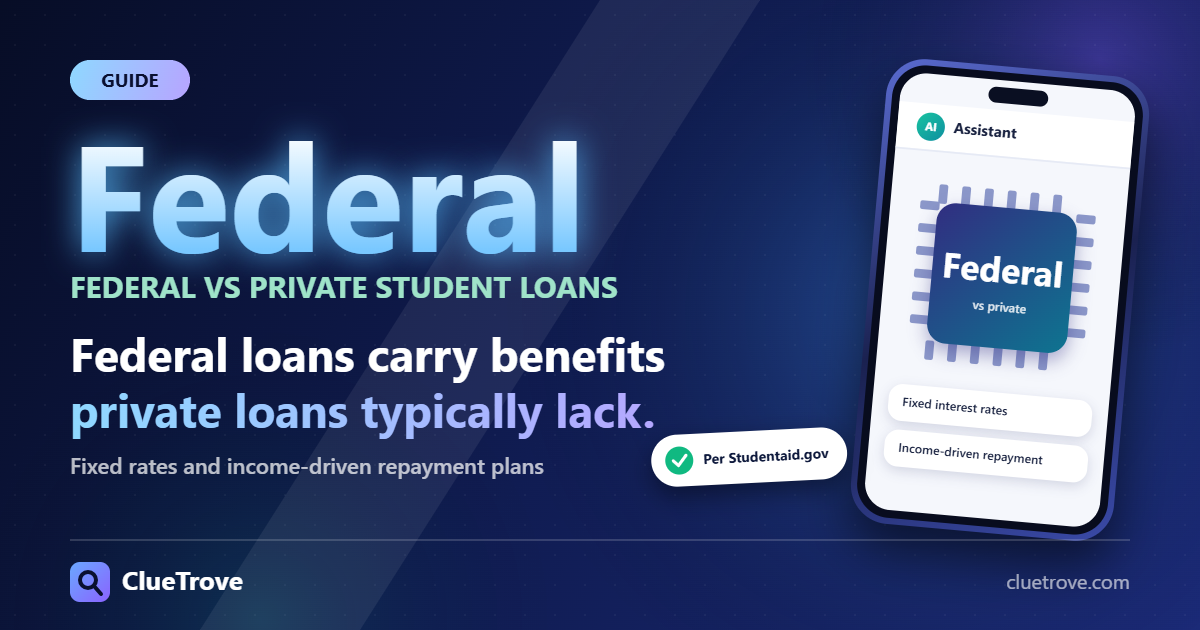
Borrow federal first. Studentaid.gov says federal loans carry benefits private loans typically lack, such as fixed interest rates and income-driven repayment plans, and that private loans are “generally more expensive.”
The short answer
- Federal loans: made by the government, with terms and conditions set by law. Studentaid.gov advises: “If you need to borrow money… start with federal loans.”
- Private loans: made by banks, credit unions, state agencies or schools, with terms set by the lender.
- Your first step: file the FAFSA, because you need it to get a federal loan.
How do federal and private loans compare?
| Federal loans | Private loans | |
|---|---|---|
| Who lends | The government | Banks, credit unions, state agencies or schools |
| Terms | Set by law | Set by the lender |
| Interest rates | Fixed | Fixed or variable |
| Credit check | None, except for PLUS loans | Often needs a credit record or cosigner |
| Payments in school | Not due until after leaving school or dropping below half-time | Many require payments in school |
| Consolidation | Can be consolidated into a Direct Consolidation Loan | Cannot be consolidated, but may be refinanced |
| Prepayment penalty | None | Varies by lender |
| Forgiveness options | Possible public-service forgiveness | Not typically |
Why does the federal route usually win?
Three differences drive the advice. A fixed rate cannot jump later. Delayed payments mean you do not pay while studying. Income-driven plans tie repayment to what you earn.
Private loans may match none of that. A variable rate can rise, many lenders want payments during school, and a student with no credit record often needs a cosigner.
What should I check before borrowing privately?
Private lenders set their own terms, so read each lender’s disclosure before you sign. Ask four things:
- Is the rate fixed or variable?
- Do payments start while you are in school?
- Do you need a cosigner or a credit record?
- Does the lender allow refinancing later?
Mistakes to avoid
- Skipping the FAFSA and going straight to a private lender.
- Assuming you can fold a private loan into a Direct Consolidation Loan. You cannot.
- Judging a private loan by its starting rate without checking whether it is variable.
- Forgetting the PLUS exception: it is the federal loan that involves a credit check.
Questions and answers about federal and private loans
Do federal loans need a credit check?
Not for most. PLUS loans are the exception.
Can I consolidate private loans into a Direct Consolidation Loan?
No. Private loans cannot be consolidated into one, though they may be refinanced.
Which loan should I take first?
Federal. Studentaid.gov says to start with federal loans if you need to borrow.
Are private loans more expensive?
Generally yes, according to studentaid.gov.
Do I pay while I am still in school?
On federal loans, payments are not due until you leave school or drop below half-time. Many private loans require payments in school.
Can a federal loan be forgiven?
Possibly, through public-service forgiveness. Private loans typically offer no forgiveness.
Sources
This guide is general information, not financial advice.
Facts last checked on 20 October 2026.