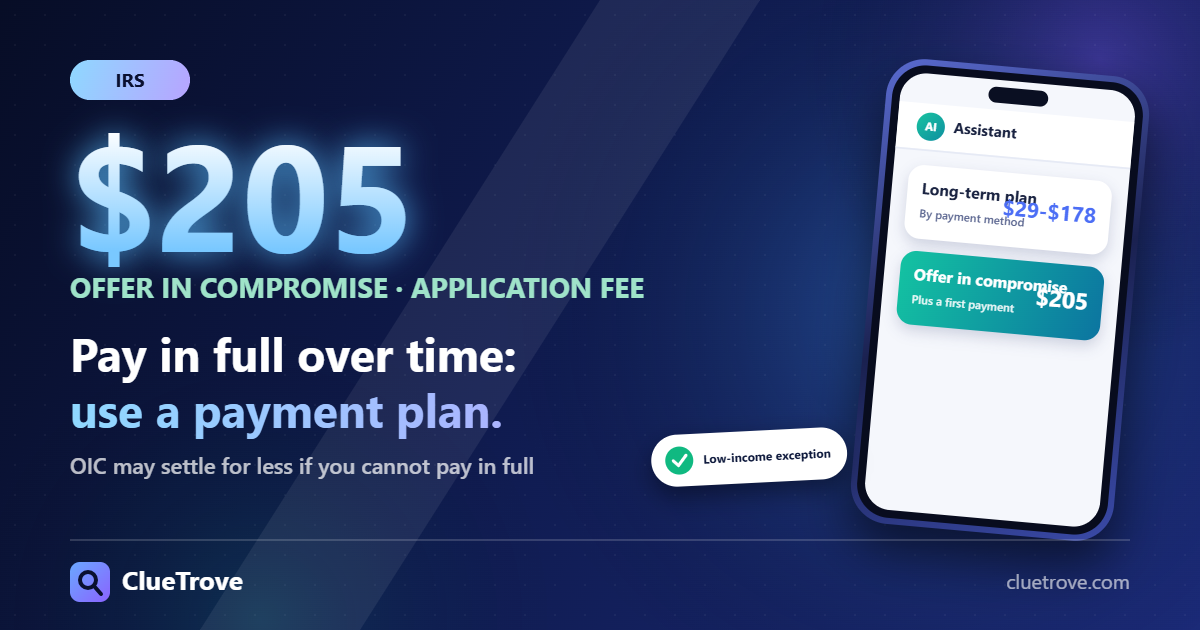
If you can pay the full tax bill over time, use a payment plan. If you truly cannot pay it in full, an offer in compromise (OIC) may settle the debt for less, but it costs a $205 application fee plus a first payment unless you meet the low-income qualifications.
The IRS describes a payment plan as “an agreement with the IRS to pay the taxes you owe within an extended timeframe,” with interest and penalties continuing until the balance is paid. An OIC “may allow you to settle your tax debt for less than the full amount you owe if you can’t pay in full or doing so would cause financial hardship.” This is general information, not tax or legal advice.
The short answer
| Payment plan | Offer in compromise | |
|---|---|---|
| What it is | Pay what you owe over time | Settle for less than the full amount |
| Interest and penalties | Continue until the balance is paid | Most collection activity is suspended while the offer is pending |
| Cost to apply | Short-term plan: no user fee. Long-term plan: $29 to $178, depending on payment method and how you apply | $205 application fee plus a first payment (unless low-income) |
| How to apply | Online, by phone, or by mail with Form 9465 | Application per the IRS page; pre-qualifier tool available |
How does an IRS payment plan work?
A page updated 3 March 2026 says the IRS now offers “simple payment plans.” You can apply online, by phone, or by mail with Form 9465. Interest and penalties continue until you pay in full, so a faster payoff costs less.
- Short-term plan: pay within 180 days. Online eligibility is for individuals who owe less than $100,000 in combined tax, penalties and interest. There is no setup fee.
- Long-term plan (installment agreement): monthly payments. Online eligibility is for individuals who owe $50,000 or less and have filed all required returns.
The IRS page lists these long-term setup fees:
- Direct debit: $29 online, $107 by phone, mail or in person.
- Other payment methods (Direct Pay, EFTPS, check, money order or card): $69 online, $178 by phone, mail or in person.
Direct debit is the cheapest long-term route. A user-fee waiver or reimbursement is available for low-income applicants whose AGI is at or below 250% of the federal poverty level and who agree to direct debit. Card payments carry processing fees.
What is an offer in compromise and who qualifies?
The IRS looks at your income, expenses and asset equity. Eligibility requires that you file all required returns, make required estimated payments, are not in an open bankruptcy, and (for employers) make federal tax deposits for the current and last two quarters. The IRS generally won’t accept an offer if you can pay in full through a payment plan, asset equity, or both. It points to its Offer in Compromise Pre-Qualifier tool to check eligibility first.
You choose how to pay:
- Lump sum: 20% of the offer with the application, then five or fewer payments after acceptance.
- Periodic payments: an initial payment with the application, then regular payments during review and until the offer is paid.
What happens while an offer is pending?
Keep making every required OIC payment. You do not have to pay an existing payment plan for the same balance. The IRS suspends most collection activity, but it may file a notice of federal tax lien, and a lien is not released until the offer is paid in full.
If the IRS doesn’t decide within two years (not counting the appeal period), the offer is automatically accepted. A rejected offer can be appealed to the IRS Independent Office of Appeals. The $205 fee is not refunded, and your payments go toward your balance. If you turn out to be ineligible, the application and fee are returned and your payments are applied to your tax debt.
Which one should you pick?
- Choose a payment plan if you can pay the full amount over months or years. It is cheaper to start, and a short-term plan under 180 days has no setup fee.
- Consider an OIC only if you cannot pay in full or full payment would cause financial hardship. Run the pre-qualifier tool first, because the IRS generally rejects offers from people who can pay through a plan or their assets.
- Low income? Check the fee waivers for both. Only individuals qualify for the OIC waiver.
- File everything first. Missing returns or estimated payments block an OIC.
What about “Fresh Start”?
There is no current IRS page by that name. It was a 2011-2012 initiative that expanded installment-agreement and OIC options, so its old thresholds do not apply. Use the payment plan and OIC pages above.
Questions and answers about the IRS Fresh Start program
Does interest stop on a payment plan?
No. The IRS says interest and penalties continue until the balance is paid.
Is there a fee to apply for an OIC?
$205 plus a first payment, unless you meet the low-income qualifications.
How much does a long-term payment plan cost to set up?
$29 online with direct debit, up to $178 by phone, mail or in person with other payment methods. A short-term plan has no setup fee.
Do I get my $205 back if the IRS rejects my offer?
No. The fee is not refunded, but your payments are applied to your balance.
Can the IRS take my money while my offer is pending?
The IRS suspends most collection activity, but it may file a federal tax lien.
Is the Fresh Start program still available?
Not under that name. Use the current payment plan and offer in compromise options.
Sources
Facts last checked on 20 October 2026.