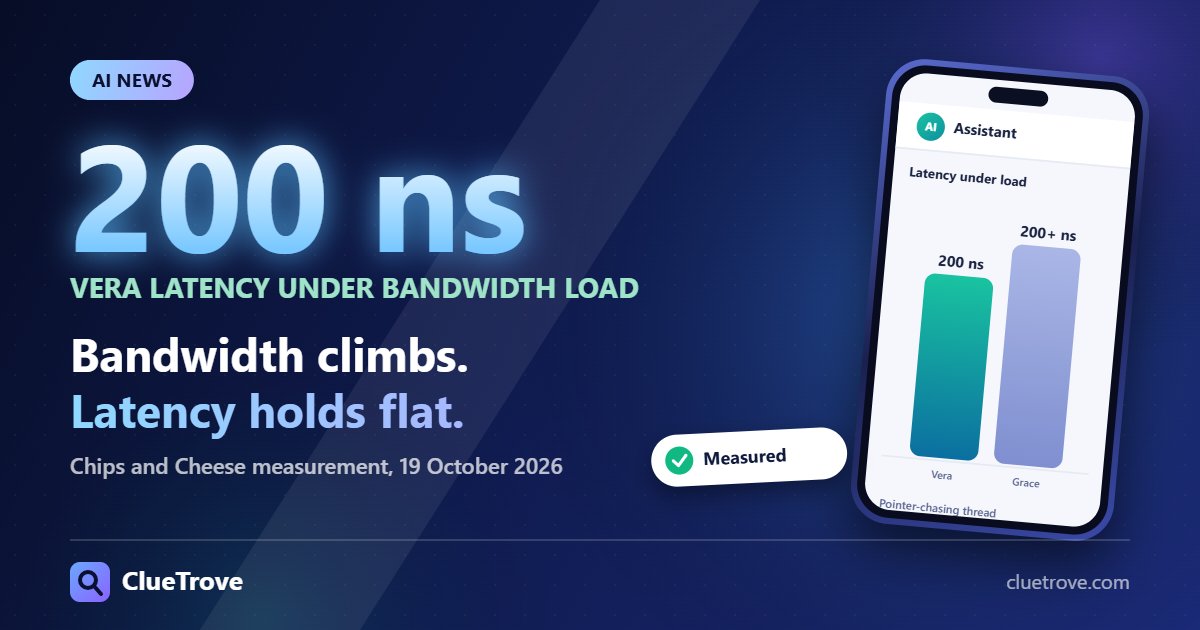
Nvidia’s Vera CPU keeps memory latency flat while bandwidth load climbs. Chips and Cheese measured a pointer-chasing thread at 200 ns or less while other threads pushed memory bandwidth toward the limit. The article is by Chester Lam and is dated 19 October 2026.
The short answer
- Memory: 1024-bit LPDDR5X-9600, with Memory Switch Nodes moving up to 1.228 TB/s.
- Latency under load: no more than 200 ns for a pointer-chasing thread while bandwidth rises. Grace was over 200 ns. Lam writes that Vera “maintains excellent control over latency under increasing bandwidth load.”
- Cross-socket: 309.27 ns load-to-use latency under load, 177.41 ns above a local access. An isolated pointer chase gave over 370 ns.
- The author’s view: a strong contender with exceptional per-core performance, bought by trading away core count.
This post summarizes Lam’s article. ClueTrove ran no tests, and the author’s exact test platform and thread counts could not be captured.
Why isn’t memory bandwidth the whole story?
Bandwidth is how much data moves per second. Latency is how long one access waits. A chip can be strong on one and weak on the other, so the article reports both.
Vera’s 1.228 TB/s comes from its memory interface and switch nodes. The author does not present it as measured application speed. Treat it as a ceiling, not as the speed your program will see.
The better sign is the latency result. Many chips slow down badly once every core asks for memory at once. Vera held its pointer-chasing thread at 200 ns or less under that pressure.
What did the cross-socket tests show?
| Test | Result |
|---|---|
| Load-to-use latency to the other socket, under load | 309.27 ns (177.41 ns above local) |
| Isolated pointer chase across sockets | Over 370 ns (author: the link doesn’t enter its higher-performance state without enough demand) |
| Cross-socket read bandwidth | Just over 587 GB/s |
| Read-modify-write bandwidth | 780 GB/s, with latency spiking to 780 ns |
| Core-to-core across sockets | About 660 ns (AMD Genoa-X cited at about 209 ns) |
The first two rows measure different situations: a loaded link and an isolated chase. The link is faster when it is busy. Do not merge the two into one speed figure.
By our own arithmetic, 309.27 minus 177.41 puts a local access at about 131.86 ns. A remote access under load therefore costs a little over twice a local one.
Core-to-core traffic is the weak spot. About 660 ns across sockets is roughly three times the 209 ns cited for Genoa-X (our division, 660 / 209). Software that bounces data between threads on different sockets will feel it.
What does the author conclude?
Lam calls Vera “a very strong contender in today’s server landscape, with exceptionally strong per-core performance backed by tremendous memory bandwidth.”
He says it trades core count for per-core performance. It should do well in DRAM-bound workloads, where it can outscale chips with more cores. It trails Graviton 5 in cache-friendly workloads and socket-level throughput.
L3 bandwidth is about 3.35 TB/s total, or 33.1 GB/s per core with all cores active. A single core reaches 88.5 GB/s uncontended. Our division gives about 2.7 times more for a lone core than for each core in a fully loaded chip.
Who should care, and who can skip it?
- Care: teams running memory-hungry jobs such as databases, analytics and in-memory caches, where DRAM is the bottleneck.
- Care: teams that plan two-socket servers and pin threads across sockets.
- Skip for now: cache-friendly or socket-throughput workloads, where the author says Graviton 5 leads.
What should you do next?
- Read the original Chips and Cheese article for the full test setup.
- Match the results to your workload: DRAM-bound or cache-friendly.
- We suggest keeping communicating threads on one socket, since the cross-socket numbers are the weakest in the table.
- Do not use the 1.228 TB/s figure as a prediction of application speed.
Questions and answers
Is Vera faster than other server CPUs?
It depends on the workload. The article shows it ahead where DRAM limits performance and behind Graviton 5 in cache-friendly and socket-level tests. It gives no overall ranking.
Is 1.228 TB/s the speed my application will see?
No. It comes from the memory interface and switch nodes, and the author does not present it as measured application speed.
Why are there two cross-socket latency numbers?
They measure different situations. 309.27 ns is under load. Over 370 ns is an isolated pointer chase, where the author says the link does not enter its higher-performance state.
Does Vera keep latency low when memory is busy?
Yes, in this test. A pointer-chasing thread stayed at 200 ns or less while other threads pushed bandwidth toward the limit.
Terms in plain language
- Latency: how long one memory access waits.
- Bandwidth: how much data can move per second.
- Pointer chasing: a test that follows a chain of memory addresses, so each step waits for the last.
- Socket: one physical processor slot. Two-socket servers have two processors.
- L3 cache: fast memory shared by cores, closer to them than main memory.
Sources
Facts read on 20 October 2026.