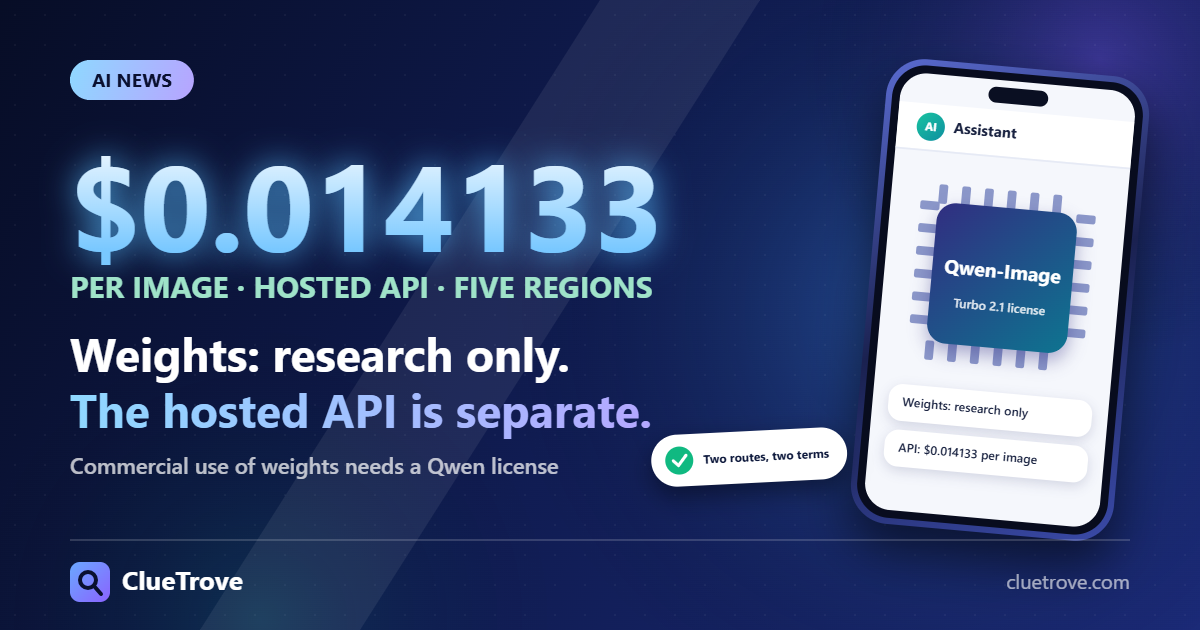
You cannot use the downloadable Qwen-Image-2.1-Turbo weights to make money. Their license allows non-commercial research and evaluation only, and commercial use needs a separate license from Qwen. The hosted API from Alibaba Cloud is a different route with different paper, and it costs $0.014133 per image in five regions.
So the real question is not “is it open?” but “which route am I on?” Answer that before you ship a single generated image to a client or a customer.
The short answer
- Weights (Hugging Face): Qwen Research License, dated 20 September 2026. Non-commercial research or evaluation only. Ask Qwen for a commercial license if you want more.
- Hosted API (Alibaba Cloud Model Studio): $0.014133 per image in five regions and $0.016 in Singapore, per the page updated 14 October 2026.
- Who owns API output: the pricing page is silent. The Model Studio Service Agreement (the Chinese text) keeps IP in generated content with you unless otherwise agreed, and asks you to evaluate risk before commercial use.
- Arabic text in images: neither Qwen nor Alibaba claims it, and no independent test covers it. Test your own samples.
What is the model, according to Qwen?
The official repository describes a unified text-to-image and image-editing model. It supports up to 10 reference images and native RGBA transparency.
Qwen-Image-2.1 was released on 20 September 2026. The Turbo checkpoint and the hosted Pro and Turbo APIs followed on 9 October.
The Hugging Face model card lists about 7 billion parameters and an 8-step denoising schedule with CFG set to 1, run through Diffusers. The 8-step claim describes speed, not quality. Neither Qwen page publishes quantitative image-quality benchmarks, so do not treat “Turbo” as proof that the pictures are better.
Route 1: what does the open-weights license allow?
It allows testing and study. It does not allow selling images, using them in a paid product, or delivering them as client work. Those uses need the separate commercial license.
| Clause (paraphrased) | What it means in practice |
|---|---|
| Non-commercial purposes only; “non-commercial” means research or evaluation | Fine for testing and studying the model |
| No commercial use without a separate commercial license from Qwen; requests go to model-business@notice.qwencloud.com | Selling images, using them in paid products or client work needs that license. No process, price or term for it is published in the license file |
| Separate license needed for uses not expressly agreed | Gray areas are not opened by default |
| “Built with Qwen” / “Improved using Qwen” attribution when the materials help create or improve a distributed AI model | Applies to derived models |
| Copy of the agreement, notice file, delete on termination, Chinese law and Hangzhou courts | Standard obligations to read before redistribution |
The text sets no user-count or revenue threshold, so a small commercial use is not exempt. A solo freelancer is in the same position as a large studio.
Do not confuse this license with the Apache 2.0 license on the older Qwen-Image repository page, which covers a different model. This is a plain-language reading of the published file, not legal advice.
Route 2: what are the hosted API price and terms?
| Model | Posted price per image | Notes on the page |
|---|---|---|
| qwen-image-2.1-turbo | $0.014133 (China, US, Germany, Japan, Hong Kong); $0.016 (Singapore) | 120 requests per minute; text and image input, image output; fine-tuning supported |
| qwen-image-2.1-pro | CNY 0.25 (same five regions); CNY 0.283404 (Singapore) | No language or commercial terms listed |
The Turbo page calls the model “open-source” even though the weights license is non-commercial. It lists no free quota, resolutions or supported languages.
Two official Model Studio documents govern the output.
- Service Agreement (Chinese text; its URL path carries the date 2023-07-28): IP in synthesized content remains with you unless otherwise agreed or required by law. Judging whether the content has IP, and who owns it, is your job. The agreement warns that AI-generated content cannot fully avoid IP disputes and that other customers may get similar content. It asks you to assess carefully before external commercial use. It also bars using model output to train or develop competing products without written permission. We could not confirm that this is the version in force for international accounts, or that an English version reads the same.
- Service-Specific Terms (English): the service makes no commitments about generated content, and you bear legal responsibility for its use. Content from trial services may be used only to evaluate the model, not for commercial purposes. AI-generated content must be labeled. These clauses are written for trial services and application tools, and there is no separate clause for image models.
- The page listing open-source model terms covers other vendors’ licenses (DeepSeek, GLM, Kimi, MiniMax) and does not mention Qwen-Image.
Which route fits which user?
- Hobbyists and researchers: the weights are enough. Keep your use non-commercial.
- Freelancers, agencies and shops selling images: the weights are off the table until Qwen grants a commercial license. The hosted API is the practical path, but the ownership wording still leaves a risk to weigh.
- Anyone training a competing model on the output: the Service Agreement bars it without written permission.
- Anyone who needs Arabic or right-to-left text inside images: test first. No source covers it.
How can you use it cautiously?
- Test with the open weights for evaluation only, and keep a note that the use is research.
- For commercial work, either request Qwen’s commercial license for the weights, or use the hosted service. In that case, read the agreement in force on your account and weigh the IP risk it describes.
- Render your own sample prompts, including any non-English text you need, before assuming support.
- Count cost per accepted image, not per generated image. See why a cheaper AI model can cost more per finished task.
Questions and answers
Can I use Qwen-Image-2.1-Turbo commercially for free?
No. The published weights license allows non-commercial research and evaluation only. Commercial use needs a separate license from Qwen or the paid hosted API.
How much does the hosted API cost?
$0.014133 per image in five regions and $0.016 in Singapore, per Alibaba Cloud’s page updated 14 October 2026.
Who owns images generated through the API?
Under the Service Agreement text, IP in the generated content stays with you unless otherwise agreed. The same agreement warns of possible disputes and asks for risk assessment before commercial use. Check the version that applies to your account.
Does it render Arabic text?
Treat it as untested. Neither Qwen nor Alibaba claims Arabic support. We suggest you run your own Arabic prompts and check letter joining and right-to-left order before you rely on it.
Does a small business need the commercial license?
Yes, for the weights. The license sets no user-count or revenue threshold, so size does not exempt you.
Terms in plain language
- Weights: the downloadable model files.
- Hosted API: using the model on the vendor’s servers and paying per image.
- Non-commercial license: a license that bars uses meant to earn money.
- RGBA transparency: an image channel that lets parts of the picture be see-through.
Sources
- Hugging Face model card
- License file
- Qwen-Image-2.1 repository
- Alibaba Cloud Model Studio: qwen-image-2.1-turbo
- Model Studio: qwen-image-2.1-pro
- Model Studio: service-specific terms
- Model Studio: Service Agreement (Chinese)
- Model Studio: related agreements
- CivArchive text-rendering test, 24 September 2026
Facts last checked against the linked pages on 15 October 2026. The only independent test found (CivArchive, 24 September 2026) covers the base 2.1 model on English and vertical Japanese layouts, not Turbo and not Arabic. Terms and prices can change. This is not legal advice.