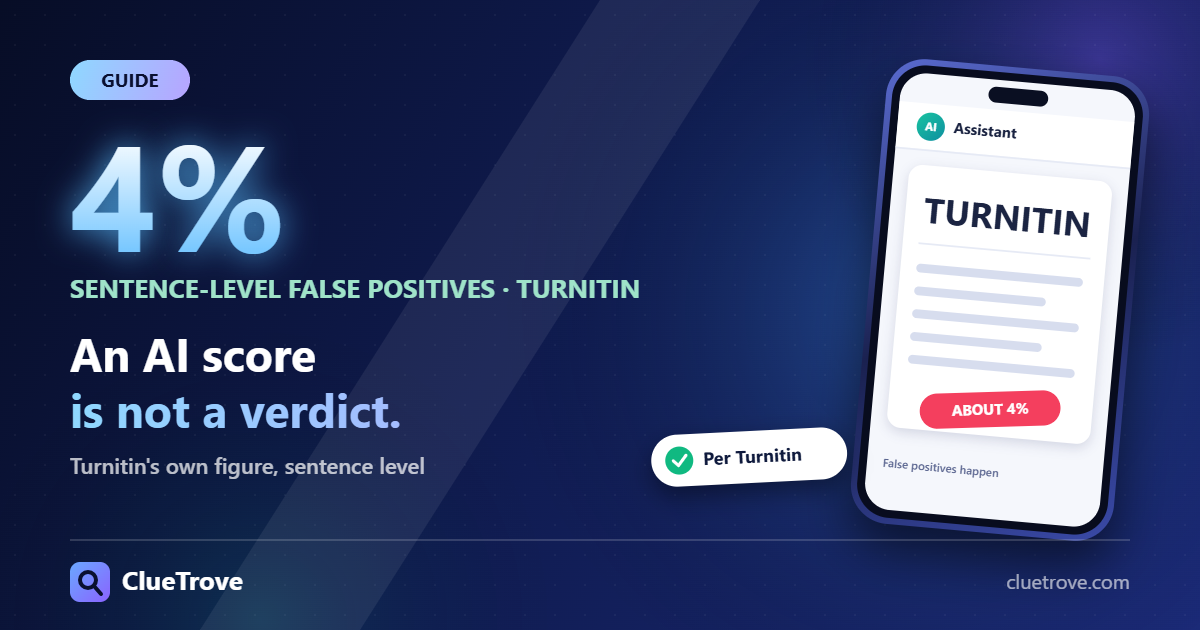
No. AI detectors are not reliable enough to serve as proof, and the companies that sell them say so. Turnitin puts its sentence-level false positive rate at around 4%, and Grammarly states that “No AI detector is 100% accurate.”
A score is a reason to look closer at a piece of writing, not a verdict on who wrote it. Here is what Turnitin, Grammarly and OpenAI publish about their own tools, what independent research found, and what to do if your work gets flagged.
The short answer
- Not proof: the vendors themselves warn against using a score on its own.
- False positives happen: Turnitin gives about 4% at sentence level and under 1% at document level.
- Low scores are hidden: since 8 July 2024, Turnitin shows an asterisk instead of a number for scores between 1% and 19%.
- Bias risk: a peer-reviewed 2023 study found seven detectors flagged human-written TOEFL essays as AI at an average rate of 61.3%.
- If flagged: keep drafts and version history, and ask for a human review.
How accurate is Turnitin’s AI detector?
Turnitin’s chief product officer, Annie Chechitelli, set out the figures in a June 2023 blog post, and Turnitin repeated the document-level number in September 2024.
- Document level: a false positive rate below 1% for documents with 20% or more AI writing. That means a fully human-written document wrongly marked as containing AI.
- Sentence level: “Our sentence-level false positive rate is around 4%.”
- August 2025: when Turnitin launched a feature aimed at AI “humanizer” tools, Chechitelli again put the false positive rate at less than one percent, Plagiarism Today reported.
What does 4% mean in practice? Out of every 100 sentences Turnitin highlights as AI-written, about 4 may have been written by a person. In a 2,000-word essay with a handful of highlighted lines, those lines alone say very little about how the essay was written.
Why Turnitin hides scores below 20%
Turnitin found that false positives are more common at low scores. In May 2023 it started adding an asterisk to scores under 20% to mark them as less reliable. Since 8 July 2024, scores between 1% and 19% are not shown at all: the report displays an asterisk with no score and no highlighted sentences. A University of Wisconsin-Superior help page updated in August 2026 describes the same rule.
So if your instructor sees an asterisk instead of a number, the detector found something below its own reliability threshold, and Turnitin does not put a score on it.
How accurate is Grammarly’s AI detector?
Grammarly says its detector “achieves 99% detection accuracy” and ranks first on RAID, an independent benchmark for telling human and AI text apart. That is a benchmark result, not a promise about your essay. The same page is blunter in its FAQ. Detectors “do not track authorship, which means even human-written text can be flagged as AI-generated,” and AI detection “should never be used as a standalone verification method.”
Why did OpenAI retire its AI classifier?
OpenAI released an AI text classifier on 31 January 2023. On its challenge set it correctly identified 26% of AI-written text as “likely AI-written” and wrongly labeled human-written text as AI-written 9% of the time. OpenAI called it “not fully reliable” and said it should not be used as a primary decision-making tool.
A note at the top of the announcement now reads: “As of July 20, 2023, the AI classifier is no longer available due to its low rate of accuracy.” The company behind ChatGPT shut down its own detector less than six months after launch, which is worth remembering whenever another vendor quotes a near-perfect number.
Do AI detectors wrongly flag non-native English writers?
Yes, and this is the best-documented risk. A study by Liang, Yuksekgonul, Mao, Wu and Zou, published in the journal Patterns on 10 July 2023, tested seven widely used GPT detectors on 91 TOEFL essays written by people. The detectors labeled more than half of them as AI-generated, with an average false positive rate of 61.3%. All seven agreed that 19.8% of the human-written essays were AI-written. Writing samples from native English speakers in the same study were identified correctly.
The detectors tested were 2023 versions, so the exact rates describe that moment. The pattern is what matters if you write in English as a second language, as many Arabic speakers do for school and work. Language models do not handle every kind of language equally, a point our look at how Arabic dialects change LLM accuracy shows from another angle.
AI writing also has habits that human readers notice. A recent study on why AI-generated English is hard to read found that models use more inanimate subjects with animate verbs and more rare word sequences than people do.
What should I do if an AI detector flags my work?
- Keep drafts, notes and version history (Google Docs or Word history) as evidence of how you wrote the piece.
- Ask your instructor or employer what evidence beyond the score they consider. Grammarly’s own page says a detector result should never stand alone.
- If the report shows an asterisk, point out that Turnitin attaches no score or highlights to results below 20%.
- Be ready to explain your content, your process and your key ideas in person.
- If you used an AI tool in a way your course allows, say so and cite it. Our guide to using and citing ChatGPT covers the basics.
- Skip “humanizer” tools. They can change your meaning, and Turnitin added a feature in 2025 aimed specifically at text run through them.
Who should lean on a detector, and who should not?
Instructors can use a score as one signal next to the rubric and a conversation with the student. They should not use it alone to accuse anyone. Students and non-native writers gain the most from keeping a paper trail before they submit.
If a disputed assignment could affect your final grade, our free GPA calculator shows how much one course grade moves your overall average, so you know what is at stake before you appeal.
This is general information, not academic or legal advice.
AI detector accuracy: frequently asked questions
Does a 0% AI score prove I wrote it myself?
No. Detectors make mistakes in both directions. OpenAI’s own classifier caught only 26% of AI-written text on its challenge set, so a low score is not proof of human writing either.
What does an asterisk mean in a Turnitin AI report?
It means the AI score is under 20%. Since 8 July 2024, Turnitin shows no number and no highlights for scores between 1% and 19%, because false positives are more common in that range.
Is Grammarly’s 99% accuracy claim reliable?
It is a vendor claim based on the RAID benchmark. Grammarly’s own FAQ says no AI detector is 100% accurate and that results should never be used as a standalone verification method.
Can a school use an AI score alone to fail a student?
That depends on the school’s own policy, but both Turnitin’s published false positive rates and Grammarly’s guidance argue against it. Ask for the policy in writing and for a human review of your work.
Sources
- Turnitin: understanding the false positive rate for sentences (14 June 2023)
- Turnitin: AI writing detection, what academic leaders need to know (12 September 2024)
- Higher Ed Dive: Turnitin adds an asterisk for scores under 20% (7 June 2023)
- University of Georgia CTL: academic honesty and generative AI
- University of Wisconsin-Superior: Turnitin AI detection (updated 10 August 2026)
- Plagiarism Today: Turnitin launches anti-AI humanizer feature (27 August 2025)
- Grammarly: AI detector
- OpenAI: new AI classifier for indicating AI-written text (31 January 2023)
- Liang et al.: GPT detectors are biased against non-native English writers, Patterns (10 July 2023)
Read this in Arabic: مدى دقة كاشف الذكاء الاصطناعي في Turnitin وGrammarly