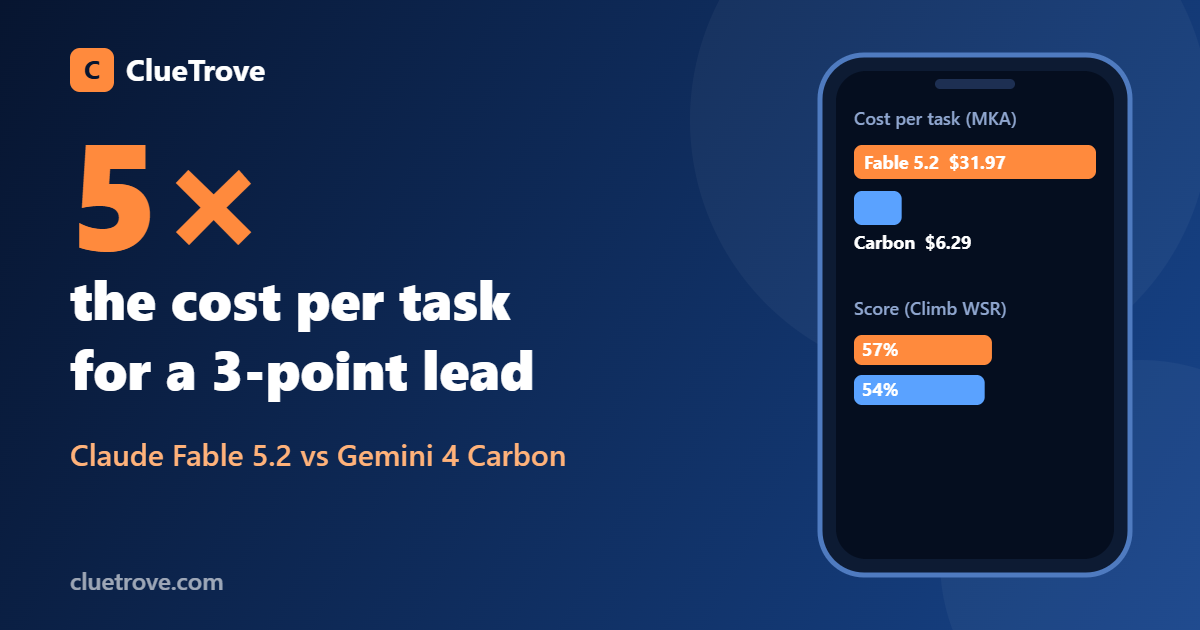
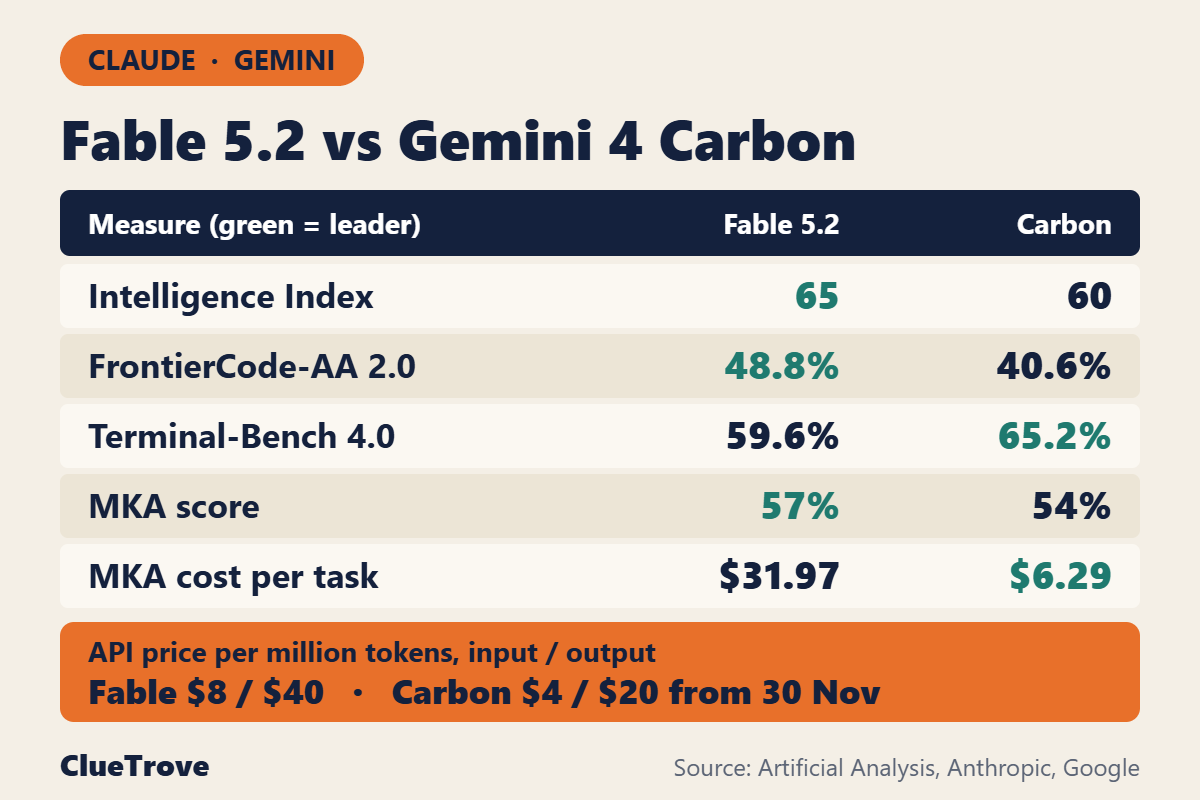
Claude Fable 5.2 beats Gemini 4 Carbon on the overall Artificial Analysis Intelligence Index, 65 to 60, and on FrontierCode-AA 2.0. Carbon wins Terminal-Bench 4.0 and costs far less: on the MKA benchmark Fable cost about 5.1 times as much per task for a three-point lead. Pay for Fable when one bad result costs you more than the price gap, and default to Carbon for high-volume work you can check automatically.
Price per token
| Model | Details |
|---|---|
| Fable 5.2 | Input: $8 · Output: $40 |
| Carbon now | Input: $2 · Output: $10 |
| Carbon from 30 Nov | Input: $4 · Output: $20 |
Prices are per million tokens. Anthropic lists Fable 5.2 at $8 input and $40 output through the API, and $16 and $80 in fast mode on some channels (9 November). Google lists Carbon at an introductory $2 and $10 until 30 November 2026, then $4 and $20 (10 November). Fable’s list price is four times Carbon’s introductory rate and two times its standard rate. Budget on the $4 and $20 price, since the introductory rate ends in less than two weeks.
Cost per task: the MKA benchmark
MKA (Multimodal Knowledge Agent) is a Google DeepMind benchmark that Artificial Analysis runs. It has 200 private tasks across 10 industries, where agents work through visually dense project files such as drawings and scans and produce reports, spreadsheets and slide decks. The Climb WSR score is the importance-weighted share of the harder rubric criteria an agent satisfies, graded by a model.
| Model | Score and cost |
|---|---|
| Fable 5.2 (Max) | 57% at $31.97 a task |
| Carbon (High) | 54% at $6.29 a task |
Opus 5.5 at Max scored 53%. Over 1,000 tasks the two averages come to about $31,970 on Fable and $6,290 on Carbon, a difference near $25,700 for roughly three points of rubric coverage. These costs come from the benchmark runs, so they are a yardstick, not a forecast of your bill.
Where each model leads
| Measure | Fable vs Carbon |
|---|---|
| Index score | 65 vs 60 |
| FrontierCode | 48.8% vs 40.6% |
| Terminal-Bench | 59.6% vs 65.2% |
| Cost to run | $22,191 vs $8,240 |
The rows are the Artificial Analysis Intelligence Index v5.0.1, FrontierCode-AA 2.0, Terminal-Bench 4.0, and the cost of running the full index. Fable leads the index and FrontierCode-AA 2.0 by about eight points; Carbon leads Terminal-Bench 4.0 by about five and a half. Running the full index cost about 2.7 times more on Fable. Artificial Analysis prices Carbon at its standard $4 and $20 here.
A rule of thumb by workload
- Choose Fable for complex software work judged on quality, for dense documents, drawings or scans where a reviewer’s time is expensive, and for jobs where one bad output costs hours of rework.
- Choose Carbon for terminal-style agents, high-volume jobs, prototypes, and anything where tests can check the result.
- Mix them: run Carbon first and send only the failures to Fable.
Effort level is a cost lever
Damien Flandrin of Gekkode ran Fable 5.2 in Claude Code at Extra effort with internet access blocked, on five coding challenges. On the four he also gave to Gemini 4 Argon, an earlier Google model, Fable took 7 hours 42 minutes in total against 1 hour 43 minutes, with similar scores. On one challenge a lower effort level matched Extra’s score in far less time. Try a lower effort level before paying for the maximum.
Test it on your own tasks
- Pick 20 to 30 real tasks from your own work.
- Run them on Carbon, then run only the failures on Fable.
- Record the cost per task and the minutes of human fixing.
Anthropic’s launch offer for Pro and standard Team seats ran through 16 November 2026 at 11:59 pm Pacific, capped at 50% of weekly limits and open to accounts paid before 9 November. Fable usage now runs on credits where enabled.
Quick answers
Is Fable 5.2 better than Carbon?
On the Intelligence Index, yes: 65 against 60. On Terminal-Bench 4.0, no: Carbon scores 65.2% to Fable’s 59.6%.
How much more does Fable cost?
Per token, four times Carbon’s introductory rate and two times its standard rate. On MKA, about 5.1 times per task.
When does Carbon’s introductory price end?
On 30 November 2026, when it doubles to $4 and $20.
Can I predict my bill from these numbers?
Benchmark costs reflect that test’s tasks, settings and token use. Measure your own tasks for a bill estimate.
Related reading
- Gemini 4 Hydrogen vs Carbon vs Fable 5.2: What Tests Show
- Gemini 4 Carbon Tops the Index at 59, but Not Everywhere
Sources
- Anthropic: Claude Fable 5.2 and Mythos 5.2, 9 November 2026 (edited 11 November)
- Claude Help: Fable 5.2 launch offers
- Google: Gemini 4 Carbon now available, 10 November 2026
- Artificial Analysis: MKA announcement
- Artificial Analysis: MKA methodology
- Artificial Analysis: Fable 5.2 vs Gemini 4 Carbon
- Gekkode: Claude Fable 5.2 review, 11 November 2026
Updated 18 November 2026. The 1,000-task totals are our arithmetic on the published averages. General information, not financial advice.
Read this in Arabic: https://cluetrove.com/fable-5-2-vs-gemini-4-carbon-cost-decision-ar/