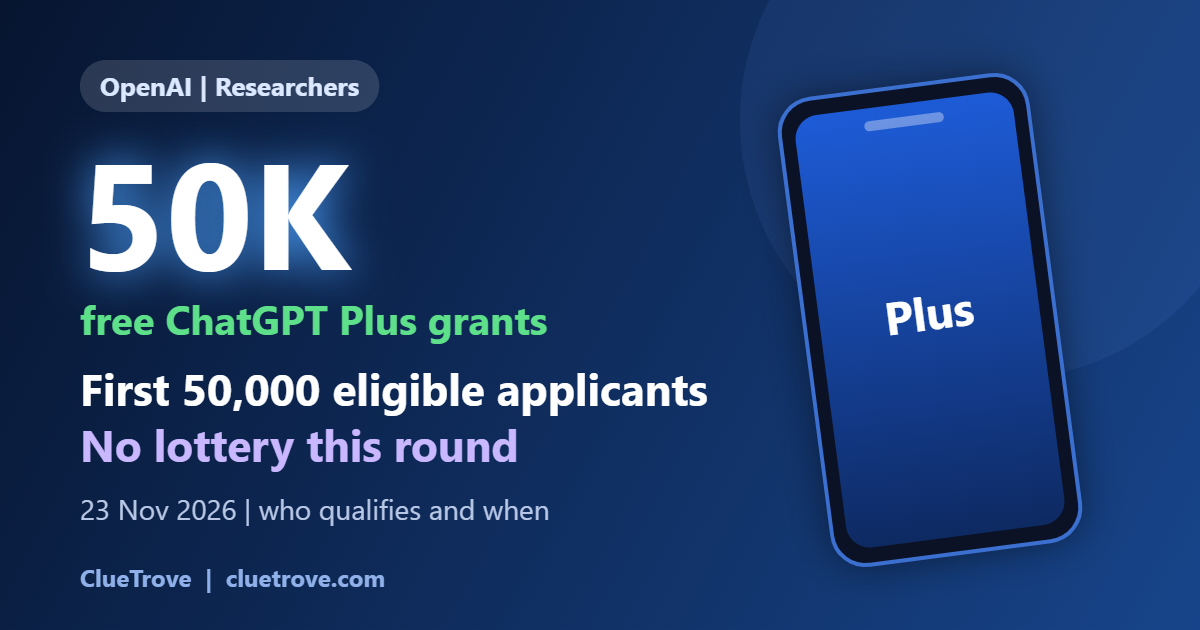
OpenAI is giving out 50,000 new grants in the next round of its ChatGPT for Academic Researchers program. Each grant gives a researcher and up to two collaborators free ChatGPT Plus, which covers up to 150,000 people. OpenAI’s 16 November announcement says applications open Monday, 23 November, and that the first 50,000 eligible applications win, with the lottery gone. The program’s overall goal is 200,000 researchers.
What a grant gives
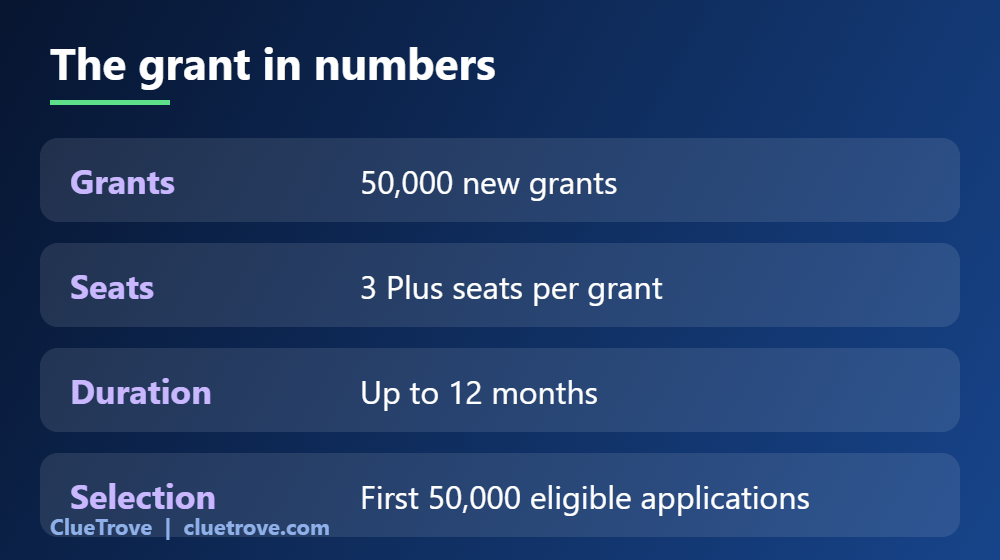
| Item | Detail |
|---|---|
| Plan | ChatGPT Plus, free |
| Seats | Three: the researcher plus up to two collaborators |
| Duration | Up to 12 months, per the Help Center |
| API credits | Not included |
Collaborators must be eligible people at the same institution as the researcher, and SheerID verification may be required. Research students at the same institution can be collaborators, though students cannot apply on their own.
Who qualifies
- A research faculty member or postdoctoral researcher at an eligible academic institution in a supported country.
- Published research in the past three years in an eligible field: Biological Sciences, Chemistry and Materials, Computer Science, Earth and Planetary Sciences, Engineering, Mathematics or Physics.
- A plan to use ChatGPT for academic research.
The Help Center adds that meeting the criteria does not guarantee approval. Neither OpenAI page lists the supported countries.
What changed from the pilot
- Selection: the lottery is gone. Access goes to the first 50,000 applications that meet the eligibility requirements.
- Plan: the July pilot gave ChatGPT Pro. New grants give Plus, because OpenAI says most participants would have stayed within Plus usage limits.
- Goal: 200,000 researchers, double the goal announced when the pilot launched.
- Reach so far: 20,000 researchers in 33 countries have joined since July.
OpenAI also cites a companion study, Science at the Frontier, that covered more than 1,800 researchers during the summer pilot. A map in the announcement shows waitlist signups by estimated institutional country as of 12 November 2026, with the United States the largest.
Timing and status
The announcement says applications for the next round open on Monday, 23 November, with no time or time zone given, and links the application page at chatgpt.com/academic-researchers/apply. The Help Center has not switched to open yet: it still states that new applications are closed and that signups join an informational waitlist, which does not count as an application. Researchers already on the waitlist who qualify get an email before applications open with activation instructions.
Data and support
OpenAI says it does not use data shared through the program to train its models by default, and the Help Center describes business-level data protections. Questions go to science@openai.com or the Help Center chat. For other free options, see free AI chatbots compared and how to run an LLM locally with Ollama, and for OpenAI’s current models, GPT-6.2 Astra vs Sol.
After approval: setup steps
- Follow the setup instructions in the approval email.
- Sign in with the email address tied to the approved application and use the same address for verification.
- Complete verification and workspace setup.
- Invite up to two eligible collaborators from your institution.
The Help Center notes that a verified email can belong to only one workspace, and that the workspace owner and the account email cannot be changed. Workspace admins can view, access, export, audit, retain and delete data tied to the workspace. For self-serve access, the promotional period begins when the researcher account is provisioned.
FAQ
Is selection still a lottery?
No. OpenAI moved away from lottery-based selection after researcher feedback. The first 50,000 eligible applications get access.
Why Plus instead of Pro?
OpenAI says most participants in the pilot would have stayed within ChatGPT Plus usage limits.
How many people can one round cover?
Up to 150,000, because each grant covers the researcher and up to two collaborators.
Which research fields are eligible?
Biological Sciences, Chemistry and Materials, Computer Science, Earth and Planetary Sciences, Engineering, Mathematics and Physics.
Can the grant include API credits or single sign-on?
No. The offer covers ChatGPT access only, and SSO, SCIM and domain claiming are not available.
Sources
- OpenAI: Broadening access to AI for scientists, 16 November 2026
- OpenAI Help Center: ChatGPT for Academic Researchers
Read this in Arabic: منح ChatGPT Plus المجانية للباحثين: الشروط والتقديم