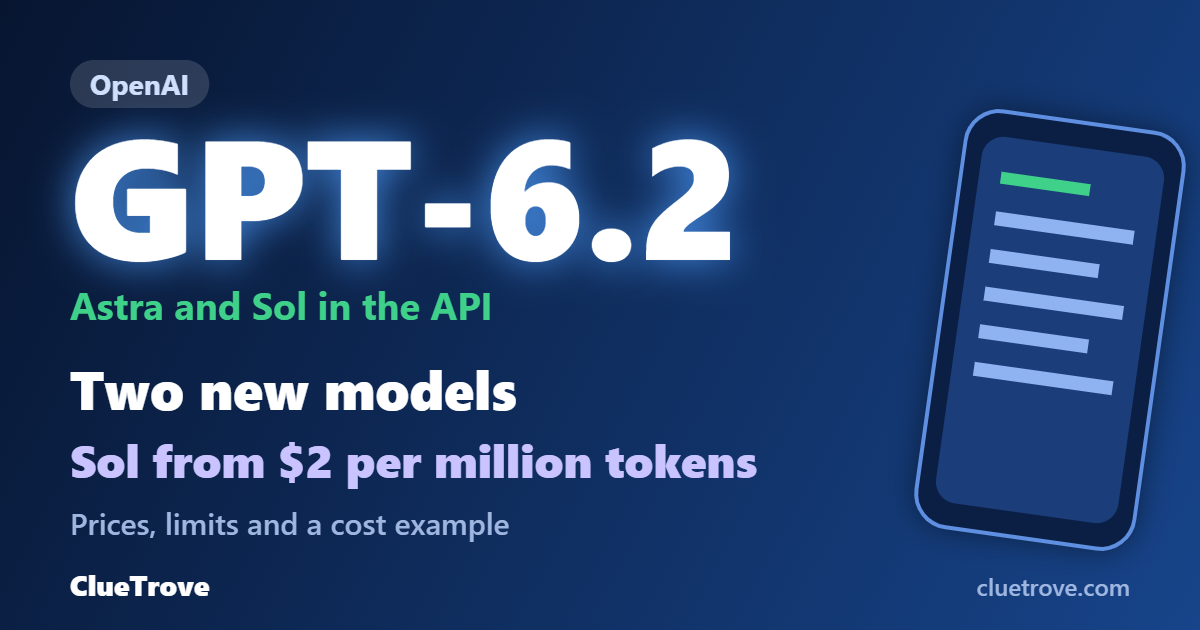
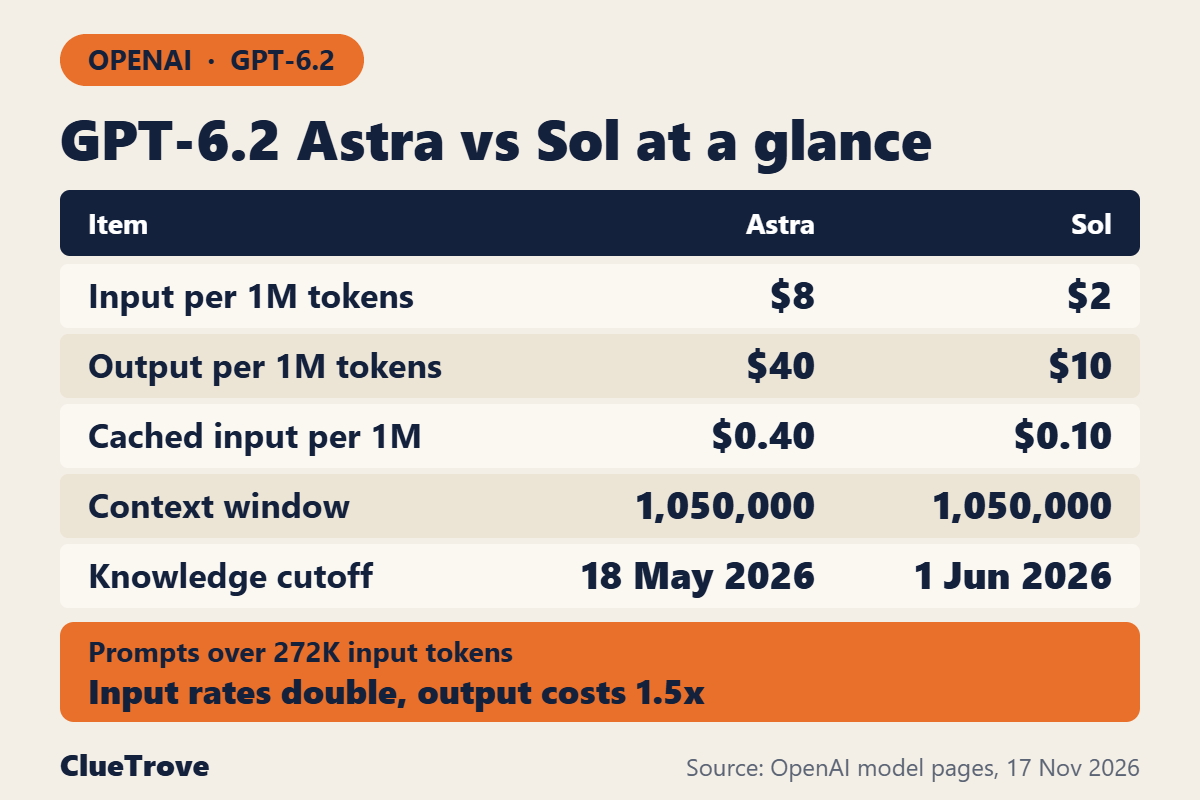
OpenAI released GPT-6.2 Astra and GPT-6.2 Sol in its API on 17 November 2026. Sol costs $2 per million input tokens and $10 per million output tokens; Astra costs four times that on every line, $8 and $40. On the example below, Sol runs about $15,000 a month and Astra $60,000, so start with Sol and send Astra only the work Sol cannot do.
GPT-6.2 API pricing, line by line
| Model | Input / cached / cache write / output |
|---|---|
| GPT-6.2 Astra | $8 / $0.40 / $10 / $40 |
| GPT-6.2 Sol | $2 / $0.10 / $2.50 / $10 |
Prices are per million tokens. The cache write price covers 30 minutes of retention, and a 12-hour cache write costs $20 per million for Astra and $5 for Sol on short-context requests at Standard pricing. Cached input costs one-twentieth of the normal input rate on both models, and that single fact changes the whole budget, as the next section shows.
How much does GPT-6.2 cost per month?
Take a service that makes 10,000 requests a day, each with 20,000 input tokens and 1,000 output tokens, for 30 days. That is 200 million input tokens and 10 million output tokens every day.
| Setup | Sol / Astra per month |
|---|---|
| Standard, no caching | $15,000 / $60,000 |
| 80% of input cached | $5,880 / $23,520 |
| Eight-hour background window | $9,000 / $36,000 |
The figures are computed from the listed rates; the caching row leaves out cache write charges, and the background row applies the 40% discount for the eight-hour window to Standard rates. The lesson is that how you call the model matters more than which one you pick. Cache the shared part of your prompt, and move work that nobody waits for into a background window. For a sense of scale, Alibaba’s Qwen4-Max lists $1.5 input and $4.5 output per million tokens in Singapore, and our guide to cheaper tokens and bigger bills explains why the per-token price alone misleads.
When the GPT-6.2 price jumps or drops
Long prompts are where bills surprise people. Above 272K input tokens, input and cache rates double and output costs 1.5 times the short-context rate, for the full request, not just the part above the line. A 300,000-token prompt with a 5,000-token answer costs $1.275 on Sol and $5.10 on Astra, against $0.65 and $2.60 if the same tokens were billed at short-context rates.
Other modes move the price in both directions. Batch costs 50% of Standard rates; Fast mode costs twice the Standard rate for the same context length; Ultrafast costs three times Standard through 28 February 2027 and six times from 1 March 2027 (Pacific time). The background completion windows in the Responses API, a public beta, lower token rates by 30% for a two-hour window and 40% for an eight-hour window, and they also cover GPT-6.1 Terra and GPT-6 Luna.
GPT-6.2 Sol or Astra: which one to use
OpenAI describes Astra as its most capable model for the hardest projects, from start to finish: it can build and revise software, use a computer and work with documents. It describes Sol as its go-to model for everyday work, from coding to powering agents at scale. Both accept text and images and answer in text, and both have a 1,050,000-token context window, 922,000 maximum input tokens and 128,000 maximum output tokens. Astra’s knowledge cutoff is 18 May 2026 and Sol’s is 1 June 2026.
Our suggestion is to run your real tasks on Sol first and send only the failures to Astra. At four times the price, Astra has to save you more in retries and review time than the gap costs. We apply the same test in our Fable 5.2 versus Carbon comparison.
What to change in your code
OpenAI says tool calling requires the Responses API, so move any tool-using code there. The API rejects requests that set reasoning effort to none. GPT-6.2 also changes how the Responses API preserves reasoning when you edit the prefix of a conversation, and it handles the top-level instructions field differently. OpenAI’s GPT-6.2 migration guide has the details. Test the prompts that edit history or set instructions first, and compare them with your GPT-6.1 results before you switch traffic.
GPT-6.2 rate limits and supported features
| Tier | Per minute |
|---|---|
| Build | 5,000 requests, 1M tokens |
| Launch | 10,000 requests, 4M tokens |
| Grow | 15,000 requests, 40M tokens |
Streaming, function calling and structured outputs are supported. Fine-tuning, audio and video are not. In the Responses API the tools include web search, file search, image generation, code interpreter, hosted shell, apply patch, skills, computer use, MCP and tool search, and a Multi-agent beta lets the model delegate work to subagents.
Where 6.2 sits in the GPT-6 family
| Date | Release |
|---|---|
| 3 September | GPT-6 Astra |
| 22 September | GPT-6 Sol and Luna |
| 29 September | GPT-6.1 Sol |
| 26 October | GPT-6.1 Terra |
| 17 November | GPT-6.2 Astra and Sol |
GPT-6.2 Sol keeps the $2 input and $10 output price that GPT-6.1 Sol launched with.
Quick answers
How much does GPT-6.2 Sol cost?
$2 per million input tokens, $0.10 cached, and $10 per million output tokens.
How much does GPT-6.2 Astra cost?
$8 per million input tokens, $0.40 cached, and $40 per million output tokens.
What happens above 272K input tokens?
Input and cache rates double and output costs 1.5 times the short-context rate, for the full request.
Can I set reasoning effort to none?
No. The API rejects it.
Can I fine-tune GPT-6.2?
No. Fine-tuning is not supported.
Related reading
- Qwen4-Max API Pricing: Worked Costs and Model ID
- Fable 5.2 vs Carbon: Cost per Task and Who Wins Where
- Gemini 4 Hydrogen: What You Get in Search, App and API
Sources
- OpenAI API changelog, 17 November 2026
- OpenAI: GPT-6.2 Astra model page
- OpenAI: GPT-6.2 Sol model page
Updated 18 November 2026. Information only, not purchasing advice.
Read this in Arabic: سعر GPT-6.2 Astra وSol: كم تكلّف شهريًا وأيهما تختار؟