Bottom line: no public test crowns one of these three models for every job. Each test measured something different, at a different effort level, so the useful move is to match the model and setting to your task and verify on your own samples.
Gemini 4 Hydrogen is the cheap-per-token option, Gemini 4 Carbon sits in the middle, and Claude Fable 5.2 costs the most per token and, in the one deliverables test below, per task. This guide separates the measurements so you can see what each one supports.
Who needs this model comparison
Care if you pick models for coding tools, document workflows, batch classification or an API budget, or if your team uses GitHub Copilot. You can ignore it if you use one chat app with a fixed model and never see a bill or a model picker.
The three price lists, kept apart
A price per million tokens is not the cost of a task, and neither is what you are billed. Thinking tokens count as output, so a higher effort setting raises the task cost without changing the list price.
| Model | Details |
|---|---|
| Gemini 4 Hydrogen | Input / output per 1M tokens (USD): 1.50 / 7.50 · Context window: 1M tokens · Source note: Google launch post and Gemini API pricing page; no introductory price listed |
| Gemini 4 Carbon | Input / output per 1M tokens (USD): 2.00 / 10.00 until 30 Nov 2026, then 4.00 / 20.00 from 1 Dec 2026 · Context window: 1M tokens (Artificial Analysis) · Source note: Gemini API pricing page; the current price is introductory |
| Claude Fable 5.2 | Input / output per 1M tokens (USD): 8 / 40 standard; 16 / 80 in the optional fast mode · Context window: 1M tokens (Artificial Analysis) · Source note: Anthropic announcement dated 9 Nov 2026 |
Do not budget December on Carbon’s current price. For how Carbon and Fable compare on cost, see our earlier piece, Claude Fable 5.2 vs Gemini 4 Carbon: is it worth the cost?, and for Carbon’s launch details, Gemini 4 Carbon: benchmarks, price and access.
Announced is not the same as available to you
- Hydrogen: Google’s launch post is dated 12 Nov 2026 (last updated 13 Nov). It lists the Gemini API, Google AI Studio, Android Studio, the Gemini app and Google Search, with extra business and subscriber routes. Which one you get depends on your plan.
- Fable 5.2: announced 9 Nov 2026 and listed as available on all platforms, including AWS, Google Cloud and Microsoft Azure. Mythos 5.2, which Anthropic says shares Fable’s base model but differs in safeguards and access, is limited to vetted organizations.
- GitHub Copilot: GitHub’s 13 Nov changelog says Hydrogen is rolling out gradually on Copilot Pro, Pro+, Max, Business and Enterprise. Business and Enterprise administrators control access through model policy. The same day GitHub announced that on 14 Dec 2026 it retires several Copilot models, including Gemini 3.8 Flash (suggested replacement Hydrogen), Gemini 4 Argon (Carbon) and Claude Fable 5 (Fable 5.2). If your Copilot workflows pin one of those, retest on the replacement before that date.
What each test actually measured
1. Artificial Analysis Intelligence Index: a general index, by setting
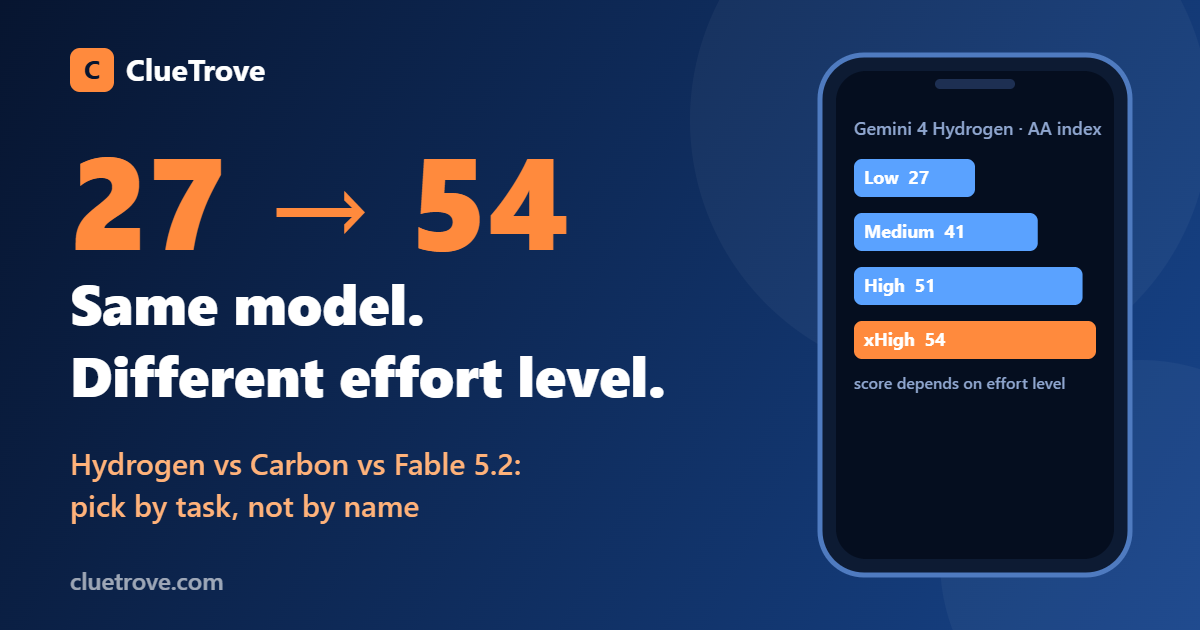
Artificial Analysis reports Hydrogen at 27 (low), 41 (medium), 51 (high) and 54 (xhigh). Carbon scores 54 (low), 58 (medium) and 60 (high). Fable 5.2 scores 54 (low), 56 (medium), 62 (high and xhigh) and 65 (max). The setting changes the score a lot, so quoting “Hydrogen scores 51” without “at high” is misleading. The index is a composite and says little about your specific job.
2. MKA: documents, attachments and deliverables
Google DeepMind designed this test of 200 private visual tasks across 10 sectors, and Artificial Analysis hosts it. It reports a weighted satisfaction rate on expert rubrics. Fable 5.2 at max scored 57% at an average of $31.97 per task. Carbon at high scored 54% at $6.29 per task, about 5 times cheaper for a 3-point gap. Grading is done largely by an AI judge, the tasks are private, and Artificial Analysis says no model leads every sector. The page did not list Hydrogen, so I make no MKA claim about it.
3. MathArena: a separate math board
The overview shows Carbon (high) at 85.4% (±3.0%) with an expected cost of $15.70, and Fable 5.2 (max) at 82.8% (±5.3%) at $40.20. The page does not define “expected cost”, so treat these as the board’s own estimates, not per-million prices or invoices. The error margins overlap, so this is not a clear win for either model. Hydrogen was not listed.
4. TrueStandard: invented citation IDs, one narrow test
TrueStandard gave each model 30 claims with no web access and asked for up to three peer-reviewed sources per claim. Fifteen claims had real research behind them and fifteen were invented, so the right answer for those was to decline. On 13 Nov 2026, at low thinking, Hydrogen produced 113 DOIs and 1 was fabricated (0.9%), against 31 of 141 (22.0%) for Gemini 3.8 Flash at low. At Hydrogen’s default high setting, 0 of 99 DOIs were fabricated.
The denominator is the DOIs each model produced, not all claims, and the authors checked them against Crossref and DataCite. They say it was one day, not repeated, that identical setting names mean different amounts of thinking across models, and that search was not tested. Neither model gave a source for any of the fifteen invented claims, and the single fake Hydrogen DOI sat beside two correct ones. This is not a general hallucination rate, and Carbon and Fable were not in it.
5. Ahmet Balaman: thinking levels on one coding task
The author asked Hydrogen for a dependency-free Node.js script that checks blog posts against ten rules, once per level in Google AI Studio. All four outputs passed all 18 hidden test files. Times: low 14.3 s, medium 21.2 s, high 45.3 s, xhigh 197.6 s. His calculated costs at paid API prices were $0.024, $0.048, $0.075 and $0.401. Those are estimates, because AI Studio runs were not billed, and he calls it a small test, not a benchmark. One easy task cannot separate the levels by capability. It only shows that on this task the higher levels bought no extra correctness.
Decision matrix by task
| Task type | Details |
|---|---|
| Well-specified code or structured output you can test automatically | Reasonable starting point: Hydrogen at low or medium, raise the level only on failures · Evidence behind it: Balaman: all levels passed one task, at 14.3 s vs 197.6 s · Limit of that evidence: One task, one run per level, no other model compared |
| High-volume simple classification or extraction | Reasonable starting point: Hydrogen, with a manual check of a sample · Evidence behind it: Lowest list price of the three · Limit of that evidence: No public test of this task here; price alone is not quality |
| Citations or references from memory, no web access | Reasonable starting point: Do not trust any model; verify every link against the claim · Evidence behind it: TrueStandard: 1 fake DOI in 113 (low), 0 in 99 (high) · Limit of that evidence: Hydrogen vs Gemini 3.8 Flash only; one day; DOI existence, not relevance |
| Mixed documents, attachments, real deliverables | Reasonable starting point: Carbon at high first; Fable at max for your hardest cases · Evidence behind it: MKA: 54% at $6.29 vs 57% at $31.97 per task · Limit of that evidence: Private tasks, AI judge, no Hydrogen; averages across sectors |
| Math with a cost cap | Reasonable starting point: Test Carbon and Fable on your own problems · Evidence behind it: MathArena: 85.4% (±3.0%) vs 82.8% (±5.3%) · Limit of that evidence: Overlapping margins; cost is the board’s estimate; no Hydrogen |
| Maximum general capability, price secondary | Reasonable starting point: Fable 5.2 at max · Evidence behind it: Index: 65 vs Carbon high 60 vs Hydrogen xhigh 54 · Limit of that evidence: Composite index; says nothing about your task or about non-English quality |
| Teams inside GitHub Copilot | Reasonable starting point: Check which of these your plan lists, and retest before 14 Dec · Evidence behind it: GitHub changelogs of 13 Nov · Limit of that evidence: Rollout is gradual; admin policy can hide models |
A test-it-yourself plan (not something we ran)
This is a plan only. We did not run any of it.
- Pick 20 real tasks from your own work and write the pass condition for each before you run anything.
- Run each task on the models you can access, at one fixed effort level per model, and record which levels you used.
- Record time, token counts from the provider’s usage data, and whether each output passed.
- Compute cost per passed task from your actual usage, not from list prices.
- Repeat the failures once at a higher effort level and note whether it fixed them.
- For anything with citations, check each link against the claim it supports.
What to do this week
- Write down which effort level your current scores or claims refer to.
- Set Carbon’s 1 December price into any budget that extends past 30 Nov 2026.
- If you use Copilot, check whether you rely on a model retiring on 14 Dec.
- Run the plan above on a small sample before changing a production default.
One limit worth stating: Fable 5.2’s Pro and Team launch offer (capped use inside the plan) runs only through 16 Nov 2026 at 11:59 pm Pacific, so after that date your usage limits follow your normal plan terms.
Common questions
Is Hydrogen a stronger model than Carbon?
Not on the one general index we cite: at high it scores 51 against Carbon’s 60 at high. It is priced lower per token.
Does the 0.9% figure mean Hydrogen rarely hallucinates?
No. It counts invented DOIs among the DOIs Hydrogen produced in one test at low thinking. It does not measure wrong claims or irrelevant sources.
Are the MathArena costs what I would pay?
No. They are the board’s expected-cost estimates, not prices per million tokens and not an invoice.
Does a higher effort level always give a better answer?
No. In the Balaman test all four levels passed the same checks, while time grew from 14.3 s to 197.6 s. On harder tasks the picture may differ, and this test did not look.
Can I use these scores for Arabic or other languages?
The tests cited here do not report language-specific results, so check your own samples.
Terms in this comparison
- Effort or thinking level: a setting that controls how much reasoning the model does before answering; it affects speed, token use and often score.
- Blended price: a price averaged across input, output and cache using an assumed mix; not your bill.
- DOI: a registered identifier for a published paper; a fabricated DOI is one no registry has issued.
- Weighted satisfaction rate: the weighted share of rubric criteria a deliverable meets in MKA.
- Introductory price: a temporary list price that changes on a stated date.
Sources
- Google: Introducing Gemini 4 Hydrogen
- Gemini API pricing
- Artificial Analysis: Gemini 4 Hydrogen
- Artificial Analysis: Claude Fable 5.2 vs Gemini 4 Carbon
- Artificial Analysis: Multimodal Knowledge Agent (MKA)
- MathArena models
- TrueStandard: Gemini 4 Hydrogen hallucinations tested
- Ahmet Balaman: Hydrogen thinking levels test
- Anthropic: Claude Fable and Mythos 5.2
- Claude Help: Fable 5.2 launch offers
- GitHub changelog: Gemini 4 Hydrogen in Copilot
- GitHub changelog: upcoming Copilot model deprecations
Sources checked on 15 November 2026.
Read this in Arabic: Hydrogen أم Carbon أم Fable 5.2؟ اختيار النموذج بحسب المهمة والكلفة