

AWS Emulator, announced on 11 November 2026, lets your code, the AWS CLI and coding agents call AWS APIs on your own machine with no AWS account and no extra fee. Use it for fast checks of application logic in tests and CI, and keep a separate step on real AWS for permissions, security and anything that spans accounts or Regions.
What it is in thirty seconds
- A local emulator of AWS APIs written in Rust, reached over a local HTTPS endpoint, by default 127.0.0.1:9297, so only your machine can connect.
- It covers services that have an API model in the public AWS API models repository. The launch post uses Amazon S3 and Amazon DynamoDB as examples and does not publish a full service list.
- An operation it has not implemented returns HTTP 501 (Not Implemented), so a missing feature fails loudly.
- No additional service fee; you pay only for AWS resources you deploy on AWS.
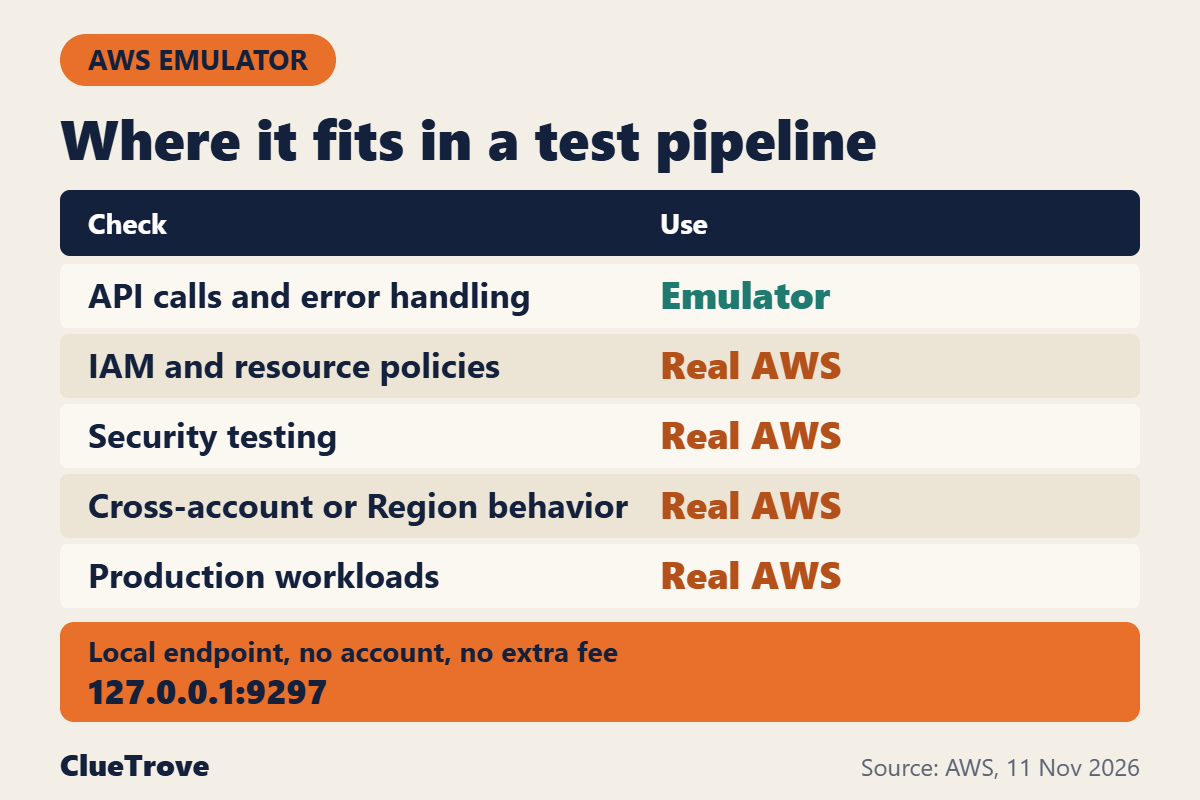
Where it belongs in a pipeline
| Question | Details |
|---|---|
| Is my API call built right? | Emulator: Yes · Real AWS: Later |
| Does my code handle errors? | Emulator: Yes · Real AWS: Later |
| Are my IAM policies right? | Emulator: No · Real AWS: Required |
| Is the app secure? | Emulator: No · Real AWS: Required |
| Cross-account or Region? | Emulator: No · Real AWS: Required |
The IAM row matters most. AWS states that a request AWS would deny can succeed in the emulator, because it does not evaluate IAM or resource-based policies as AWS does. A green local run says nothing about a missing permission. The repository says the tool is for building and testing, not production workloads or security testing. At launch it runs one account, 000000000000, with no cross-account or cross-Region behavior.
A sensible setup
- Fast stage: run your unit and integration tests against the emulator on every commit. In embedded mode for the AWS SDK for Rust, each test gets its own emulator instance with its own state, so tests can run in parallel. AWS describes this through the aws-emulator-embedded crate.
- No cloud credentials in CI: the GitHub page says the emulator runs on your machine, a dev server or in CI without an AWS account, and AWS advises keeping real credentials out of test job environments.
- Real stage: one pipeline step that runs against real AWS with the least-privilege role your app will use in production.
Fidelity scores
AWS measures how closely the emulator matches AWS with fidelity tests: short SDK programs that run a workflow and check AWS’s behavior, verified against real AWS. A test passes only when the emulator matches on each call’s status code, body, exact error code and message, and on the resources created. Scores are published per service for each release as “k of n”, for example 40 of 50, and the evaluation suite is public, failing tests included. A score can drop when new tests are added even if the emulator improves. Look up the score of each service you depend on in the AWS Emulator documentation before you rely on it.
Installing on Linux
The launch post installs from an RPM or Debian package. These commands are from AWS’s post for Amazon Linux 2023:
PKG=https://downloads.aws.com/aws-emulator/packages/aws-emulator/LTS/latest
sudo dnf install -y $PKG/aws-emulator-x86_64.rpm
aws-emulator -v
On macOS and Windows the post builds a Docker image from a short Dockerfile in the documentation, and no ready-made image is published. On start the emulator generates credentials, a config file and a certificate in ~/.aws/emulator/9297/. Access key IDs start with EMULATOR, it rejects requests signed with other keys, and it generates new keys each time it starts. SDKs such as the AWS SDK for Java need extra configuration to trust the certificate. By default it sends anonymous usage and error data, which you can turn off.
Licence, and who wrote the code
The repository is under CC0 1.0, with code in vendor/ under Apache License 2.0. Amazon says autonomous AI agents wrote the code and that its team did not write or review it. The repository does not take pull requests; for a difference from AWS, open a GitHub issue with the service, operation, SDK and version, the request sent and how the response differed.
Quick answers
Does it need an AWS account?
No.
Does it cost anything?
No additional service fee. You pay only for AWS resources you deploy on AWS.
Will it catch a missing IAM permission?
No. Test permissions on real AWS.
What happens when I call something unsupported?
It returns HTTP 501 (Not Implemented).
Can I use it for production?
No. It is for building and testing.
Related reading
- GitHub Replica: What It Needs Locally and What Sharing Costs
- How to Run Kimi and Qwen Models Locally with llama.cpp
Sources
- AWS News Blog: Test your applications against AWS locally with AWS Emulator, 11 November 2026 (updated 12 November)
- GitHub: aws/aws-emulator
- Amazon: How autonomous AI agents built AWS Emulator, 11 November 2026
Updated 18 November 2026.
Read this in Arabic: هل يكفي AWS Emulator لاختبار تطبيقك محليًا قبل الرفع إلى AWS؟


