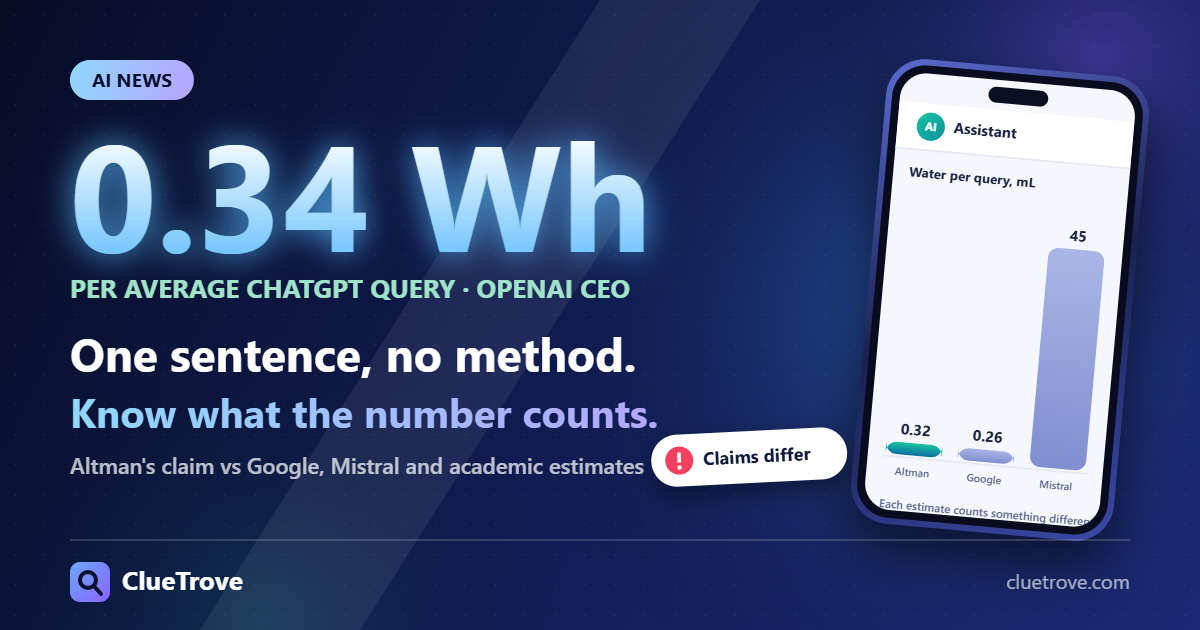
No audited figure exists. The best-known numbers are about 0.34 watt-hours and about 0.32 mL of water per average ChatGPT query, and they come from one sentence by OpenAI’s CEO with no method.
Other estimates run from 0.26 mL to 45 mL because each one counts something different. Read the boundary, not just the number. Facts checked 19 October 2026.
The short answer
- The claim: Sam Altman wrote in June 2025 that an average ChatGPT query uses “about 0.34 watt-hours” and about 0.000085 gallons of water, roughly 0.32 mL.
- The nearest rival: Google reported in August 2025 that its median Gemini text prompt uses 0.24 Wh and 0.26 mL of water.
- The outlier: Mistral’s lifecycle study put a 400-token response at 45 mL, because it counts manufacturing and other upstream impacts.
- The academic view: a paper estimated about 17 mL per request for GPT-3 in 2023.
- What to do: quote the source, date and boundary, and never compare a lifecycle figure with an operational one.
What does each source actually say?
| Source | Date | Energy | Water | What it covers |
|---|---|---|---|---|
| OpenAI (Sam Altman, blog post “The Gentle Singularity”) | June 2025 | “about 0.34 watt-hours” per average ChatGPT query | About 0.000085 gallons (roughly 0.32 mL) | One sentence; no method or model given |
| Google (Gemini Apps median text prompt, Google Cloud blog) | 21 Aug 2025 | 0.24 Wh (0.03 gCO2e) | 0.26 mL (“about five drops”) | Full-system power at production utilisation, idle machines, overhead and data-centre water; a narrower active-chip count gives 0.10 Wh and 0.12 mL |
| Mistral AI with Carbone 4 and ADEME | 22 Jul 2025 | – | 45 mL (1.14 gCO2e) per 400-token Le Chat response | Lifecycle analysis including server manufacturing, not only energy use |
| Li, Yang, Islam and Ren, “Making AI Less Thirsty” (arXiv 2304.03271) | 2023, revised 2025 | Assumes 0.004 kWh of server energy per request | About 16.9 mL per request (US average) for GPT-3; roughly 7 to 48 mL across locations | Operational water: on-site cooling plus water used in generating electricity; consumption, not withdrawal |
| Epoch AI | Feb 2025 | About 0.3 Wh per typical GPT-4o text query | – | Approximation; excludes image generation and reasoning models |
A paper by Jegham and colleagues estimated 0.42 Wh for a short GPT-4o query, with far higher figures for long prompts and reasoning models. Versions of that paper differ, so cite the paper itself if you need those numbers.
Why do the numbers disagree?
- Boundary. Google’s 0.24 Wh includes idle capacity and overhead; its narrow count is 0.10 Wh. Mistral’s 45 mL includes upstream lifecycle impacts. Altman’s boundary is undisclosed.
- Water definition. On-site cooling only, plus electricity-generation water, or the full lifecycle give very different answers. Generation water depends on the grid.
- Model and year. GPT-3 in 2023 is not a current model on current hardware. Google reported its per-prompt energy fell 33 times between May 2024 and May 2025.
- Query size. A 400-token reply, a 150 to 300 word reply and a 100,000-token prompt consume very different amounts. Epoch AI estimates about 2.5 Wh at 10,000 input tokens.
Is ChatGPT really thirstier than Gemini?
The raw numbers say yes: 0.34 Wh and 0.32 mL against 0.24 Wh and 0.26 mL. But the two companies do not state matching methods, so the gap proves nothing. Google also publishes a narrower count of 0.10 Wh and 0.12 mL, which shows how much the boundary moves the answer.
The same warning applies to the 45 mL figure. Set against 0.32 mL it looks vastly worse, yet Mistral counts manufacturing and the others do not.
Does the per-query number matter at scale?
Yes, because small numbers multiply. The International Energy Agency estimated that data centres used about 415 TWh in 2024, about 1.5% of global electricity, and projects about 945 TWh in 2030 in its base case. Per-query numbers and total demand are different questions.
PolitiFact’s September 2026 fact-check treats Altman’s water figure as unconfirmed and disputed, because it is a single sentence without method. Altman’s post also shows no date or method, so treat it as a stated claim, not an independent measurement.
How should you use these numbers responsibly?
- Quote the source, date and what it measures, not a bare “X mL per query.”
- Do not compare a lifecycle figure with an operational one.
- Treat any single-number claim, including this article’s table, as a snapshot.
- Writers and students: pick one source, name its boundary and stay inside it.
- Anyone judging an AI footprint: ask what is counted, and for which model, year and query length.
Questions and answers
How much water does one ChatGPT query use?
About 0.32 mL by OpenAI’s CEO’s 2025 statement, which has no method. Academic estimates for the older GPT-3 are far higher, near 17 mL.
Does ChatGPT use water?
Yes. Data centres use water for cooling, and electricity generation uses water too. How much is attributed to one query depends on what you count.
Is Google’s figure lower than OpenAI’s?
Yes on paper. Google reports 0.24 Wh and 0.26 mL for a median Gemini text prompt, against OpenAI’s 0.34 Wh and about 0.32 mL. The methods are not matched, so do not treat it as a ranking.
Why is Mistral’s number so much larger?
It is a lifecycle analysis. The 45 mL for a 400-token response includes server manufacturing, not only the water used when the query runs.
Are long prompts and reasoning models costlier?
Yes. Epoch AI estimates about 2.5 Wh at 10,000 input tokens, against about 0.3 Wh for a typical GPT-4o text query.
Sources
- Sam Altman: The Gentle Singularity
- Google Cloud: measuring the environmental impact of AI inference
- Mistral AI: environmental standard for AI
- Li et al.: Making AI Less Thirsty
- Epoch AI: how much energy does ChatGPT use
- IEA: Energy and AI
- PolitiFact: Altman and ChatGPT water use
Facts last checked on 19 October 2026. Estimates change as models and hardware change.