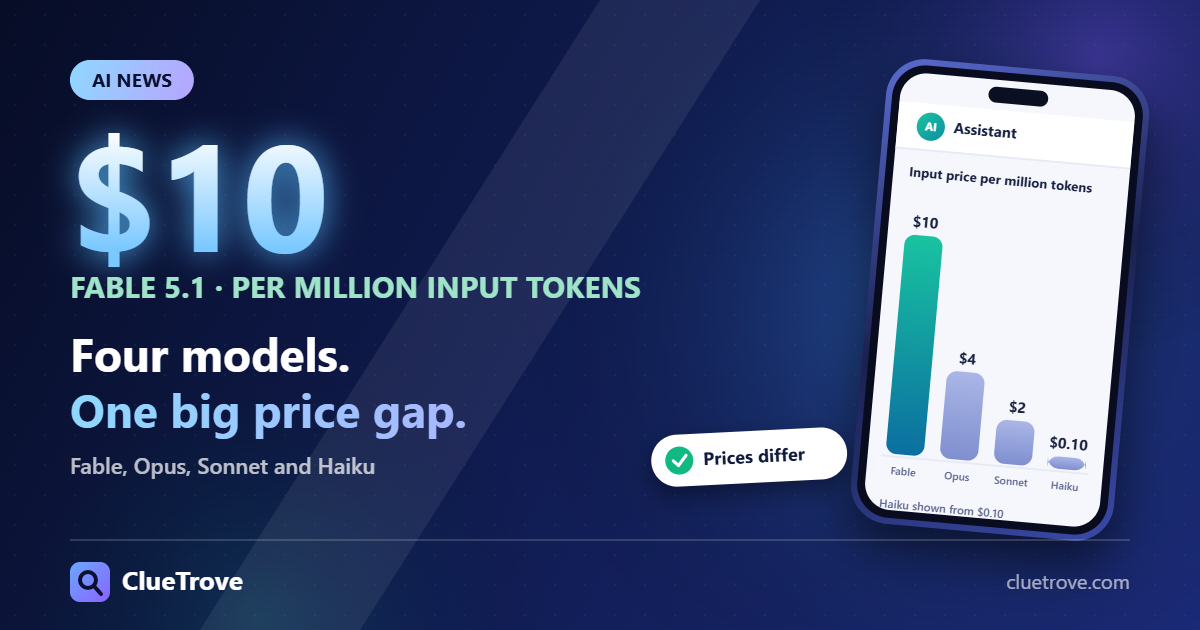
Start with Opus 5.5, as Anthropic’s docs advise, and move only when your own tests say so. Price is the big gap: per million input tokens, Fable 5.1 costs $10, Opus 5.5 $4, Sonnet 5.5 $2 and Haiku 5.5 from $0.10.
All four current models share a 1M-token context window and 128K maximum output. Output prices per million tokens are $50, $20, $10 and from $0.50. The docs add a useful rule: “tuning effort is often a better lever than switching models.” This guide covers each model’s role, API IDs, retirement dates and Claude Code names, as checked on 19 October 2026. I did not benchmark the models.
The short answer
- Fable 5.1: “for demanding reasoning and long-horizon agentic work.” Most expensive and slowest. Move here only when tests on Opus at higher effort still fall short.
- Opus 5.5: “for long-running agentic coding and knowledge work.” The docs’ suggested starting point.
- Sonnet 5.5: “the best combination of speed and intelligence.” Fast and half the price of Opus.
- Haiku 5.5: “for high-volume, latency-sensitive tasks such as classification, extraction, and routing.” Fastest and cheapest.
How do the four models compare?
| Model | API ID | Price per million tokens (in / out) | Default effort | Latency | Retirement |
|---|---|---|---|---|---|
| Claude Fable 5.1 | claude-fable-5-1 | $10 / $50 | high | Slower | Not before 1 Sep 2027 |
| Claude Opus 5.5 | claude-opus-5-5 | $4 / $20 | medium | Moderate | Not before 22 Sep 2027 |
| Claude Sonnet 5.5 | claude-sonnet-5-5 | $2 / $10 | high | Fast | Not before 28 Sep 2027 |
| Claude Haiku 5.5 | claude-haiku-5-5 | From $0.10 / from $0.50 | medium | Fastest | Not before 7 Oct 2027 |
All four have a 1M-token context window, 128K max output, a reliable knowledge cutoff of June 2026 and adaptive thinking, per the docs. Batch API is 50% off. Prompt-cache reads cost 10% of base input price on most models (2.5% on Fable 5.1 and 5% on Opus 5.5 and Sonnet 5.5). Haiku’s price is “from” because some configurations are priced lower; see Anthropic’s pricing page.
A further model, Mythos 5.1 (claude-mythos-5-1), is limited to organizations verified through Anthropic programs. Older models such as Fable 5, Opus 5, Sonnet 5 and Haiku 4.5 remain available as legacy.
What does the price gap mean for your bill?
Take a job that reads 1M input tokens and writes 100K output tokens. At list prices that is about $15 on Fable 5.1, $6 on Opus 5.5, $3 on Sonnet 5.5 and $0.15 on Haiku 5.5. Fable costs 2.5 times Opus. Sonnet costs half of Opus. Batch API takes another 50% off when the work can wait.
Effort is the cheaper dial. Lowering effort on one model trades some intelligence for lower latency and cost, with no change of model. Defaults differ: Fable 5.1 and Sonnet 5.5 start at high, while Opus 5.5 and Haiku 5.5 start at medium. Anthropic’s advice is to start at the default and adjust up or down based on your evals.
What does Anthropic recommend for each case?
- “Start with Claude Opus 5.5 for most workloads.”
- Use Fable 5.1 for demanding reasoning and long-horizon agentic work, or “when your evals on Claude Opus 5.5 at higher effort still fall short.”
- Use Sonnet 5.5 for “speed and capability for everyday coding, agent, and enterprise workloads.”
- Use Haiku 5.5 for “the lowest latency and price” and sub-agent tasks. You can also start efficiency-first with Haiku and upgrade only if needed.
- “Tuning effort is often a better lever than switching models.”
The docs give a selection matrix rather than a direct Sonnet-versus-Opus paragraph, so the list above is the guidance.
Which names work in Claude Code?
Claude Code accepts –model with the aliases sonnet, opus, haiku and fable, or a full model name. On the Anthropic API these resolve to Sonnet 5.5, Opus 5.5, Haiku 5.5 and Fable 5.1. Older versions apply on Bedrock, Vertex and Foundry. Fable models are never the default. See how much Claude Code costs for plan details.
How should you pick?
- Start with Opus 5.5 on a sample of your real tasks.
- Try Sonnet 5.5 for speed or cost, and Haiku 5.5 for high-volume simple work.
- Move up to Fable 5.1 only if your tests still fall short. Our evaluation guide shows how to test.
Mistakes to avoid
- Do not pick the most expensive model by default. Test cheaper ones and a lower effort first.
- Do not judge models on generic benchmarks alone. Anthropic says a good evaluation set built from your own prompts and data is the most important step.
- Do not hard-code a model ID without checking its retirement date.
Questions and answers
Which Claude model is best?
It depends on the job. Anthropic suggests Opus 5.5 as the starting point for most workloads. Choose Fable 5.1 for the hardest reasoning, Sonnet 5.5 for everyday speed and Haiku 5.5 for volume.
What is the cheapest Claude model?
Haiku 5.5, from $0.10 per million input tokens and $0.50 per million output tokens.
What is the Claude API model ID for Opus 5.5?
claude-opus-5-5.
Which Claude model is the most capable?
Fable 5.1 is the most capable model open to all customers, at $10 and $50 per million input and output tokens. Mythos 5.1 offers the same capabilities, but only to verified organizations.
Should I switch models or change effort?
Change effort first. Anthropic says tuning effort is often a better lever than switching models, because it trades intelligence for speed and cost inside one model.
Sources
- Claude docs: models overview
- Claude docs: choosing a model
- Claude docs: pricing
- Claude Code docs: CLI reference
Facts last checked on 19 October 2026. Models, prices and retirement dates change.