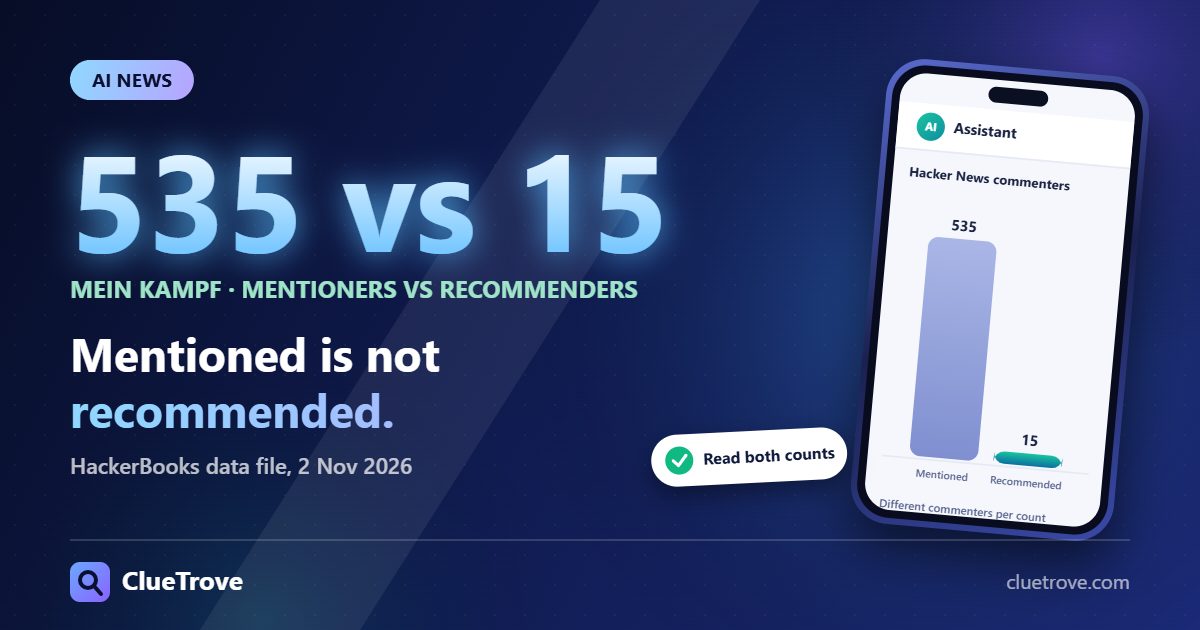
On HackerBooks, being mentioned a lot is not the same as being recommended. In the site’s own data file, Mein Kampf was mentioned by 535 different Hacker News commenters but recommended by 15.
So read the second number. The site, built by roansh with Claude, now shows both counts. The gap between them tells you more than the rank does.
The short answer
- What it is: a catalogue of books named in Hacker News comments from 2007 to 2026, each linked to the comments behind it. roansh posted it as a Show HN on 1 November 2026.
- Two counts: “mentioned by” counts every distinct commenter who named a book. “Recommended by” counts those whose comment an AI model labeled as a recommendation (HackerBooks About page, read 2 November 2026).
- Size: roansh’s post says about 16.5k books. The site’s data file, generated 2 November 2026, lists 15,766 books, 281,363 mentions, 225,861 comments and 57,773 commenters.
- Accuracy of the labels: the About page says the labels agreed with a check model 85% of the time on 400 mentions, and warns to expect some noise.
- Money: book pages carry Bookshop.org and Amazon affiliate links, disclosed in the footer and on the About page.
- Independence: the site says it is not affiliated with Y Combinator or Hacker News.
Why did a mention count fail on day one?
The first version counted mentions only. roansh’s post said so plainly: praising a book and trashing it both count.
A commenter, drayfield, then pointed out that Mein Kampf showed as recommended by 651 HN users and called it a troubling statistic. roansh replied that a wording fix was coming, and later edited the reply to say the label had changed to “mentioned by” (HN thread, 1 November 2026). Another commenter, danso, asked why Claude could not filter out the noise and show real recommendations. roansh answered that this was coming.
By 2 November it had arrived. The About page now says that counting mentions alone makes a book people merely discuss, or warn about, look like a favorite.
How does HackerBooks tell a recommendation from a mention?
Per the About page, Claude Sonnet 5.5 labeled every mention as one of four types: recommend, neutral, critical, or not about the book. Mentions that are not about the book, such as a film or a same-named work, are dropped. The Most recommended page ranks books by people who recommended them, with a floor of three recommenders in the site’s code.
The page also says the labels were checked against Claude Opus 5.5 on 400 mentions, with 85% agreement. It adds that keyword rules, sentiment scoring and a TF-IDF classifier were tried first and did worse.
What that 85% means: it is agreement with another model, not with human readers. Our arithmetic: on 400 mentions, 85% is 340 matches and 60 disagreements. Treat any single book’s recommend count as an estimate.
What do the two counts show?
These rows come from the site’s downloadable CSV, generated 2 November 2026. The share column is our arithmetic.
| Book (CSV rank) | Mentioned by | Recommended by | Share recommending |
|---|---|---|---|
| The Art of Computer Programming (rank 1) | 1,125 | 336 | 30% |
| Gödel, Escher, Bach (rank 2) | 1,055 | 505 | 48% |
| How to Win Friends and Influence People (rank 5) | 853 | 579 | 68% |
| Atlas Shrugged (rank 7) | 758 | 207 | 27% |
| Mein Kampf (rank 21) | 535 | 15 | 3% |
| Communist Manifesto (rank 126) | 206 | 31 | 15% |
Three things stand out. First, the rank follows mentions, so the number-one book is not the most recommended one. How to Win Friends and Influence People has the highest recommend count in the file, at 579. Second, Mein Kampf still sits at rank 21 by mentions, while only 15 commenters recommended it. Third, its mention count fell from the 651 drayfield saw to 535, which fits the site dropping comments that were not about the book. That last point is our inference from the two numbers.
Across the whole file, 1,136 books have zero recommenders and 8,051 have at least three. Every book has at least two mentioners, matching the rule in roansh’s post.
Where does the data come from?
The footer names two sources: HN comments from the open-index/hacker-news dataset and book details from Open Library. The About page lists five build steps:
- Start from a public archive of every HN item and comment.
- Find likely book references with regexes and light language processing: quoted titles, “by Author,” store links and ISBNs.
- Match candidates to Open Library works for IDs, authors, years, covers and subjects.
- Search the whole corpus for each resolved title, so books count even when nobody linked them.
- Use a small language model only for ambiguous titles such as Dune or Influence.
Scores weigh distinct commenters over raw mentions, so one enthusiast cannot dominate. In the thread, roansh added that the pipeline is Python and DuckDB over the HN dump, compiled offline on a laptop. The site is plain JavaScript and static JSON on Cloudflare, with covers on R2. Each book keeps 30 comments for now, and roansh suggested a refresh about once a month might be enough.
roansh’s post says Claude, using Opus 5.5, wrote almost all of it, including the data pipeline and the site, while roansh steered, made calls and bought the domain. roansh also said Claude drafted the Show HN post.
Where did matching go wrong?
These are commenter reports from the thread on 1 and 2 November 2026, with roansh’s response and what the current CSV shows. We read the HTML, script and CSV but did not run the JavaScript catalogue, so we did not test search or on-screen matches.
| Reported by | Report | Response and current CSV |
|---|---|---|
| Erlangen | Vanity Fair by Thackeray ranked too high because many comments meant the magazine | roansh said only comments naming Thackeray would count. The CSV now shows 14 mentioners, rank 3,124. |
| entuno | Harry Potter and the Sorcerer’s Stone credited to John Williams; TV series and albums in the Other category | The CSV now lists J. K. Rowling as author of that title. |
| boxed | The Three-Body Problem cover came from a different author | No reply seen. The CSV lists Cixin Liu and Ken Liu; covers are not in the file. |
| lubitelpospat | Martin Kleppmann’s “wild boar book” shown under Business and Management, and Pattern Recognition and Machine Learning under Psychology and Behavior | No reply seen. The CSV now tags Kleppmann’s Designing Data-Intensive Applications as software engineering, systems and programming, and Bishop’s book as ai-ml. |
| bazzargh | The Invention of Morel and Why’s (Poignant) Guide to Ruby missing | roansh added Why’s Guide by hand, since it was not in Open Library. Morel is still missing; roansh said the matcher misses some long-tail titles. |
| corbinh | A book nickname linked to the wrong entry | roansh said the link now goes to the actual dragon book. |
Another commenter, DuncanCoffee, asked for a way to suggest the correct author. roansh called a “suggest a correction” button a good idea.
How to read a list like this
These are our review criteria for any catalogue built automatically from comments or reviews. They are a checklist for you, not tests we ran on HackerBooks.
- Find the definition of “recommended.” Ask what one count stands for. HackerBooks now defines it on its About page. If a site does not, treat its numbers as mention counts.
- Ask who labeled it, and how well. A model’s label is a guess. Look for an error rate, like the 85% agreement HackerBooks publishes.
- Follow the count back to the evidence. Open the linked comments and read a few. On HackerBooks, a book page shows up to 30 for now.
- Check the name and the author. Automated matching can merge two works or attach the wrong cover. Confirm the author and edition before you buy.
- Look for the money and the tracking. HackerBooks discloses its affiliate links and says it is an Amazon Associate. Its About page says no tracking, and the home page also loads a Cloudflare Web Analytics script. Commenter Aurornis argued that affiliate links are why sites like this keep appearing.
- Note the cut-off. A two-mention minimum drops books only one person named. Commenter rramadass objected to it for that reason.
Who is it useful for?
Worth your time if
You want to see which books keep coming up in tech discussions and read the arguments around them. Or you want the CSV to build your own ranking.
You can skip it if
You want a short, hand-picked list. Even the Most recommended page rests on model labels, not editors.
What to do next
- Sort by Most recommended, not Top all-time, when you want reading picks.
- Compare the two counts on a book page. A small share recommending means people mostly discuss it.
- Check your library before you use a buy link. roansh noted that Bookshop.org supports independent stores.
Neither the post nor the site states a licence for the code or what the build cost.
Questions readers ask
Is HackerBooks part of Hacker News or Y Combinator?
No. The site says it is an independent project, not affiliated with Y Combinator or Hacker News.
What is the difference between “mentioned by” and “recommended by” on HackerBooks?
“Mentioned by” counts every distinct commenter who named the book. “Recommended by” counts those whose comment Claude Sonnet 5.5 labeled as a recommendation.
How many books are on HackerBooks?
The data file generated on 2 November 2026 lists 15,766 books, each mentioned by at least two different commenters. roansh’s launch post said about 16.5k.
Can I download the HackerBooks data?
Yes. The About page links a book-level CSV with rank, title, authors, Open Library ID, mentioners, mentions, recommenders, years and topics.
Does HackerBooks make money from book links?
Yes. Book pages link to Bookshop.org and Amazon as affiliate links. The About page says the commission pays for hosting at no extra cost to you.
Who built HackerBooks?
roansh, an HN user. roansh says Claude, using Opus 5.5, wrote almost all of the site and data pipeline.
Glossary
- Show HN: a Hacker News post where someone presents a project they made.
- Stance label: the AI model’s tag for a mention: recommend, neutral, critical or not about the book.
- Affiliate link: a buy link that pays the linking site a share when you purchase.
- Open Library: the book catalogue HackerBooks uses for titles, authors, covers and subjects.
Sources
- Show HN: HackerBooks, post and discussion by roansh (1 November 2026; 1,144 points and 207 comments when read on 2 November 2026)
- HackerBooks website: footer, About page and data CSV
Facts read on 2 November 2026.