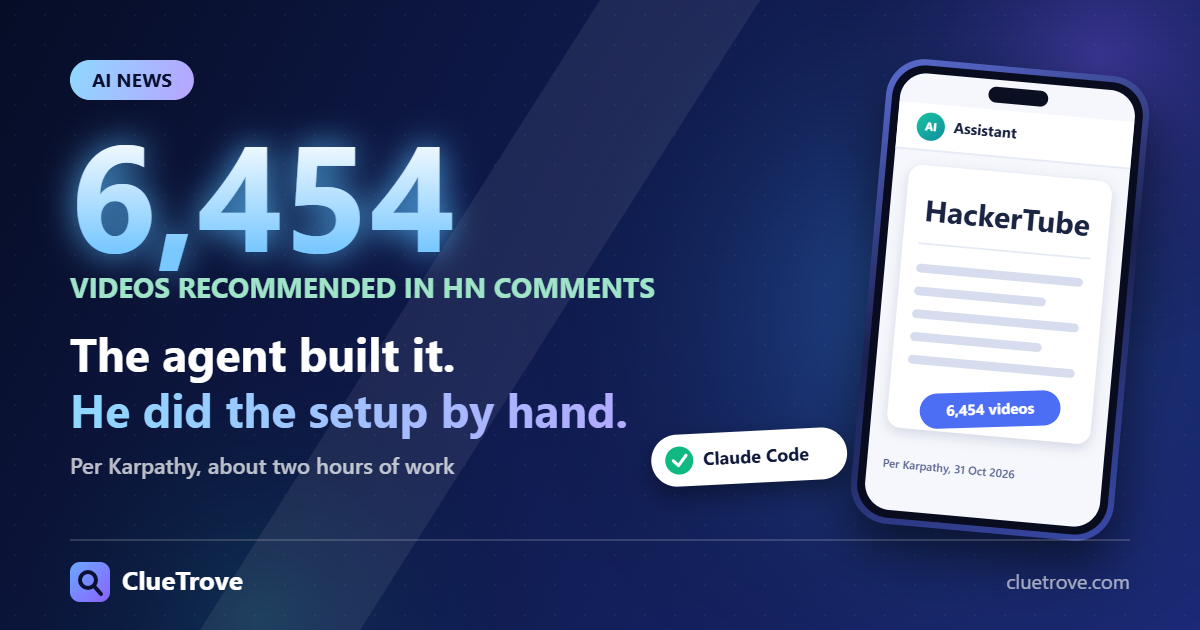
Andrej Karpathy says Claude Code built HackerTube, a YouTube-style site of 6,454 videos recommended in Hacker News comments, in about two hours. He still did the account work himself: a YouTube API key, a server, the domain and its DNS record.
That split is the part worth copying. The agent handled data, code and deployment. The human handled keys, payments and logins.
The short answer
- What it is: 6,454 YouTube videos from 2007 to 2026 across 150 topics. They come from about 40,000 Hacker News comments that recommend a video, per Karpathy’s post of 31 October 2026.
- How he built it: Claude Code’s desktop app for Mac, with Opus 5.5 on Medium effort as his default, and Sonnet run over the comments in a Claude Code Workflow.
- What he did by hand: a YouTube API key in the Google Cloud console, a VPS, the domain purchase and, per a later comment, the DNS record.
- Token use: 504 million input tokens (90% cached) and 7.6 million output tokens, by a tally he had Claude make. He is on a subscription and gave no dollar figure.
- Code: he did not publish the server. He offers a data download instead.
Who did which job?
Karpathy says he no longer reads or writes code or runs terminal commands himself. He talks to Claude and has it do the work. Here is the build as he describes it in his post and his Hacker News replies.
| Task | Done by | Where he says it |
|---|---|---|
| Download Hacker News comments from the open-index/hacker-news dataset on Hugging Face | Claude (Opus 5.5) | Post |
| Filter spam and narrow to about 40,000 comments recommending a YouTube video | Claude, running Sonnet in a Workflow | Post |
| Query YouTube for video metadata, ending at 6,454 videos | Claude, using the key Karpathy created | Post |
| Build the site: feed, thumbnails, keyboard shortcuts, data export | Claude | Post |
| Create a YouTube API key in the Google Cloud UI | Karpathy | Post |
| Boot a VPS | Karpathy | Post and thread |
| Buy the domain name | Karpathy | Post |
| Set the DNS record | Karpathy | Thread |
| Update, deploy, secure, harden and optimize the code on the server | Claude, once Karpathy gave it the server’s IP address | Post |
The dataset page, published by OpenIndex, calls it a complete Hacker News archive. It stores the data as Parquet files under the odc-by license. Karpathy adds that he worked between Claude’s tasks, so it still felt a bit like teamwork. The post does not name the VPS provider.
Our reading: the four manual jobs share one trait. Each needs a login, a payment or a credential in someone else’s console. An agent cannot finish those steps unless you hand over access. So “about two hours” describes the project, not a hands-free run.
What does the site do differently from YouTube?
Karpathy built it because he was tired of YouTube’s feed, which he calls slop with exaggerated thumbnails. He judges Hacker News picks to be better. That is his taste, not a measured quality test. The features he lists:
- A For You feed with no accounts. Your state is stored in your local browser session.
- A 50% thumbnail. In the thread he explains this is a frame from exactly halfway through the video, so you see a representative image instead of the uploaded thumbnail.
- Keyboard shortcuts, with some options in Settings.
- A data export meant to be handed to your own agent so you can build your own version.
Because the feed state lives in your browser, a second browser or device should start fresh, by our reading.
The site kept changing during the discussion. Karpathy announced a recency sort and a Filter option on the main page after readers asked for them. He later listed a sort by most recent Hacker News recommendation, upload-date filters and a Play all on YouTube button.
What did the build cost?
Asked about cost, Karpathy said he is on a subscription, then had Claude add up the usage: 504 million input tokens, 90% of them cached, and 7.6 million output tokens. He said more than 90% of that was Sonnet calls labeling the comments. The app and deployment took about 1 million Opus 5.5 tokens.
Our arithmetic from his figures:
| Item | Tokens |
|---|---|
| Cached input (90% of 504M) | about 454M |
| Uncached input (10% of 504M) | about 50M |
| Output | 7.6M |
| Opus 5.5 for the app and deploy | about 1M, or about 0.2% of the 511.6M total |
The lesson is where the tokens went. Writing and shipping the app was a sliver. Labeling tens of thousands of comments was nearly all of it. If you scope a similar project, price the data pass first.
Caching matters on the API side too. Anthropic’s pricing docs bill cache reads at 0.1 times the base input price, and at 0.05 times on Opus 5.5 and Sonnet 5.5. Our arithmetic: the 454M cached tokens would bill like about 45M fresh ones at 0.1 times, or about 23M at 0.05 times. Either way, the 50M uncached tokens weigh more on an API bill than the cached bulk.
Commenters offered dollar guesses: one put it near $250 at API prices, another near $300 in Sonnet usage. These are their estimates; we did not check them against a price list. Others noted that the server and domain keep costing money after launch, without giving amounts. Per-token prices also do not equal cost per finished job, as we explain in why a cheaper model can cost more per finished task.
Can you build your own HackerTube?
Partly. Karpathy said he did not publish the server because the code is messy. Instead, he pointed readers to a .zip of the underlying data in the site’s About section and suggested giving it to Opus 5.5 to build a similar site.
There is a catch he flagged himself: he could not distribute the YouTube data, so you would create your own free API key for that part. Before you store that metadata, read YouTube’s API Developer Policies. Section III.E.4 says certain stored API data must be refreshed or deleted after 30 calendar days. Section III.E.1.a bars caching or storing copies of YouTube audiovisual content without prior written approval. Commenters debated how these rules apply to HackerTube, and the thread did not settle it.
Karpathy also said he would trust this hands-off way of working with Opus 5.5 or newer, and not with weaker models. That is one builder’s view from one project, not a model comparison.
Who should pay attention?
Worth your time if
You plan agent-built projects and want a realistic task split. You want a calmer video feed with no sign-in. Or you want a dataset of videos that Hacker News users recommended, to build on.
You can skip it if
You want this week’s uploads. The catalog is built from past comments, so it is a collection, not a stream of new videos.
What to do next
- Before you start a similar build, list each step that needs your login, card or key. Plan to do those yourself.
- Estimate the data-processing pass separately from the coding.
- If you rebuild from the data zip, create your own YouTube API key first.
Questions readers ask
Do I need an account to use HackerTube?
No. Karpathy says recommendations work without user accounts, with state kept in your local browser session.
Where do the videos come from?
From Hacker News comments, 2007 to 2026, that recommend a YouTube video. Claude filtered about 40,000 such comments down to 6,454 videos.
Which AI models built it?
Opus 5.5 in Claude Code, on Medium effort as Karpathy’s default, with Sonnet run over the comments in a Workflow.
What is the 50% thumbnail?
A frame from exactly halfway through each video, shown instead of the creator’s uploaded thumbnail.
Glossary
- Claude Code: Anthropic’s docs describe it as an agentic coding tool that reads your codebase, edits files and runs commands. It runs in a terminal, an IDE, a desktop app and a browser.
- Workflow: the Claude Code feature Karpathy used to run Sonnet across the comments.
- VPS: a rented virtual server that hosts the site.
- API key: a credential that lets a program query a service, here YouTube’s video metadata.
- Cached tokens: per Anthropic’s docs, input read from a prompt cache, so a request can resume from a stored prompt prefix instead of processing it again.
Sources
- Andrej Karpathy, HackerTube (blog post, 31 October 2026)
- HackerTube website
- Hacker News discussion of HackerTube (1,635 points and 433 comments on 1 November 2026)
- OpenIndex, Hacker News complete archive on Hugging Face
- Google, YouTube API Services Developer Policies
- Anthropic, Claude Code overview
- Anthropic, Prompt caching
Facts read on 1 November 2026.
Part of the guide: AI model pricing and API cost guide.