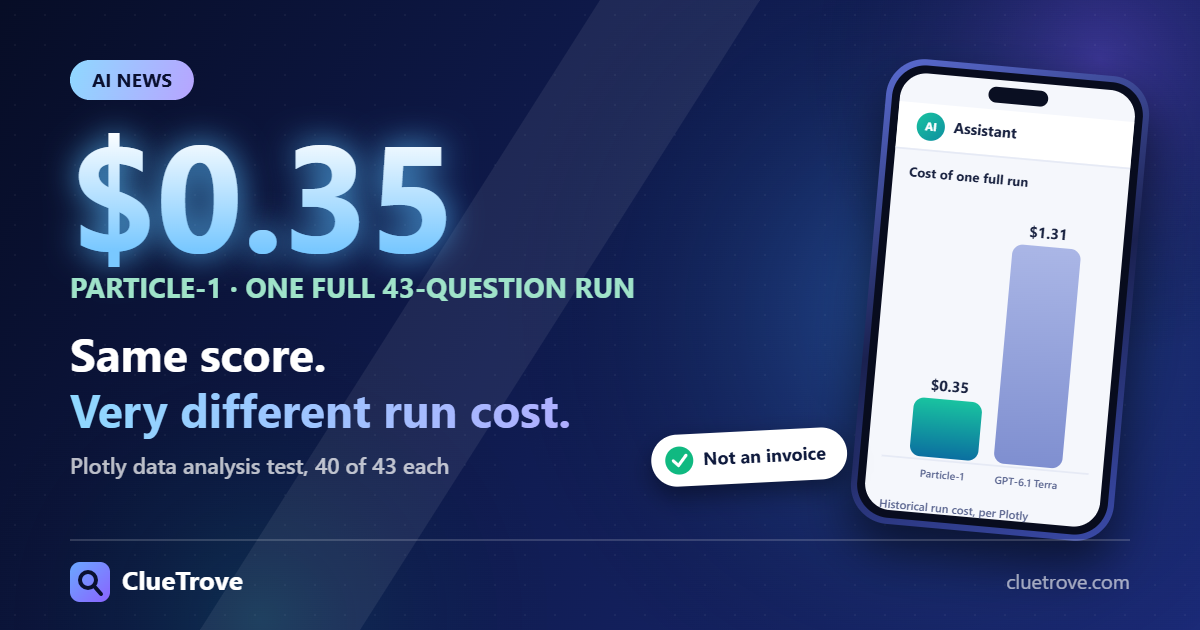
Particle-1 and GPT-6.1 Terra tied at 40 of 43 in Plotly’s updated DataAnalyticsBench. Particle-1’s whole run cost $0.35 against $1.31 for Terra, but the two models missed different questions (Plotly, updated 31 Oct 2026).
That makes this a choice about which mistakes you can live with, not just price. GPT-6.1 Sol scored 43 for $2.61, and Claude Opus 5.5 scored 41 for $13.31.
The short answer
- Same score, different misses: Particle-1 wrongly flagged good rows as untrustworthy once. Terra missed one statistics trap. Each missed two of the five hidden-needle questions (Plotly’s Particle-1 post, 31 Oct 2026).
- Budget with live prices: OpenRouter listed Particle-1 at $0.05 per million input tokens and $0.50 per million output tokens (OpenRouter, read 1 Nov 2026).
- Top of the table: GPT-6.1 Sol and GPT-6 Astra both scored 43. Sol’s run cost $2.61; Astra’s cost $19.97.
- Opus 5.5: one question above Terra, for about ten times Terra’s run cost by our arithmetic.
What did Plotly change on 31 October?
Plotly published DataAnalyticsBench on 14 October 2026, built with researchers at Mila. The 31 October update added ten models, including OpenAI’s GPT-6.1 Terra and Particle AI’s Particle-1. The table now lists 36 models (Plotly, updated 31 Oct 2026).
The test has 43 English questions in six groups: analytics (20), ambiguous (5), impossible (5), statistics (5), data quality (3) and needle in a haystack (5). Plotly defines a needle question as one that points toward a hidden pattern without naming it. Models work inside Plotly Studio Embedded, with read-only tools for listing datasets, running SQL, charting and showing tables. A judge model, Claude Sonnet 5, grades each answer with no partial credit.
How do the six models compare?
These rows come from Plotly’s results table (updated 31 Oct 2026). Cost is for the whole 43-question run, at OpenRouter prices on the day Plotly ran each model, including prompt caching where the provider supports it.
| Model | Score (of 43) | Whole-run cost | Tokens used | Median time per question | Needles found (of 5) |
|---|---|---|---|---|---|
| GPT-6.1 Sol | 43 | $2.61 | 7.9M | 18 s | 5 |
| GPT-6 Astra | 43 | $19.97 | 9.2M | 27 s | 5 |
| Claude Opus 5.5 | 41 | $13.31 | 9.3M | 27 s | 4 |
| Particle-1 | 40 | $0.35 | 16.7M | 16 s | 3 |
| GPT-6.1 Terra | 40 | $1.31 | 6.7M | 15 s | 3 |
| GPT-6 Luna | 38 | $0.13 | 5.6M | 18 s | 2 |
Watch the names. Astra and Luna are GPT-6 models, not GPT-6.1. The table also has a separate GPT-6 Sol row: 41 of 43, also $2.61 a run. Plotly places Luna, Particle-1 and GPT-6.1 Sol on its cost-accuracy frontier.
Two things stand out. First, Particle-1 used about 2.5 times Terra’s tokens, by our arithmetic, yet its run cost about a quarter as much. Its price per token is far lower, so volume did not erase the gap. Second, Opus 5.5 found four of five needles, so by our arithmetic one of its two misses was a needle. Plotly does not describe either miss.
Where did Particle-1 and Terra go wrong?
Plotly’s Particle-1 post (31 Oct 2026) breaks the 40 points down by question type. It labels the needle group “hidden needles.” Both models scored full marks on analytics, ambiguous and impossible questions.
| Question type | Particle-1 | GPT-6.1 Terra | DeepSeek V4.1 Flash (base model) |
|---|---|---|---|
| Data quality | 2 of 3 | 3 of 3 | 2 of 3 |
| Statistics traps | 5 of 5 | 4 of 5 | 3 of 5 |
| Hidden needles | 3 of 5 | 3 of 5 | 1 of 5 |
Plotly describes Particle-1’s three misses:
- Data quality audit: it checked duplicates, nulls, date ranges and units. Then it flagged a pattern as a contradiction, although the rest of the data explains it, and told users not to trust those rows.
- Alarm logs: it found several real anomalies but not the planted one.
- Wind farm underperformance: it noticed the right signal but dismissed it as a reporting artifact.
What this means for you: one of Particle-1’s misses raised a false alarm about clean data. In a real team, that can send people chasing a problem that does not exist. Terra’s weak spot in this run was a statistics trap, the kind of question where a plausible number hides a wrong method. Neither model found every hidden pattern, so a person still needs to look for what the model did not mention.
Is Particle-1 a token saver for data analysis?
Not in this test. Particle AI says Particle-1 is DeepSeek V4.1 Flash post-trained with reinforcement learning to use fewer tokens, aimed first at software engineering. On four coding and data engineering benchmarks, it reports 28.4% to 52.2% fewer output tokens than the base model. Those savings are Particle’s own results (Particle AI, 28 Oct 2026).
Plotly saw the opposite on analytics. Particle-1 used about 6,900 output tokens per question against about 6,200 for the base model. It made about 10 model calls per question against 7. Plotly concludes that the gain came from better answers, not shorter ones (Plotly’s Particle-1 post, 31 Oct 2026).
The base model also looks cheaper on current prices. Plotly says the DeepSeek V4.1 Flash run would have cost about $0.24 today, below Particle-1’s $0.35. But the base model scored 36, four fewer than Particle-1. Plotly says all four extra points came from the hardest questions.
Which price should you budget with?
The run costs above are historical: one 43-question run, on one date, through OpenRouter. They are not an invoice or a subscription price. Live token prices change and depend on where you buy. Particle-1 shows how far they can drift:
- Particle’s announcement: $0.30 per million uncached input tokens, $0.006 cached, and $1.20 output, the same as it lists for DeepSeek V4.1 Flash (Particle AI, 28 Oct 2026).
- OpenRouter: $0.05 per million input tokens and $0.50 output, with a 1.0M-token context (OpenRouter, read 1 Nov 2026).
- Cached input on OpenRouter: $0.003 per million, per Plotly’s Particle-1 post (31 Oct 2026).
Plotly also turned run costs into a yearly figure: 10 questions a day for 250 days, per person. That gives about $21 for Particle-1, $76 for Terra, $152 for GPT-6.1 Sol, $774 for Opus 5.5 and $1,161 for Astra (Plotly, updated 31 Oct 2026).
Worked example, our arithmetic, not a quote or invoice. Assumptions: a five-person team asks 2,200 questions a month, each like an average benchmark question, at the run-date prices, with no retries. Divide each whole-run cost by 43, then multiply by 2,200.
| Model | Per question (run cost / 43) | 2,200 questions |
|---|---|---|
| GPT-6 Luna | about $0.003 | about $6.65 |
| Particle-1 | about $0.008 | about $17.91 |
| GPT-6.1 Terra | about $0.030 | about $67.02 |
| GPT-6.1 Sol | about $0.061 | about $133.53 |
| Claude Opus 5.5 | about $0.310 | about $680.98 |
Your own questions will use more or fewer tokens than Plotly’s, and retries raise the total. The same idea is in our piece on why a cheaper model can cost more per finished task.
How much weight can one run carry?
Less than the table suggests. Plotly ran each model once, so there are no error bars, and it says a gap of one or two questions is within the noise (Plotly, updated 31 Oct 2026). In repeat runs of other models, scores moved by up to three points (Plotly’s Particle-1 post, 31 Oct 2026). Grading is automated by a judge model. The questions are in English, the data is synthetic wind-energy data, and Plotly says results may differ on other data or phrasing. Plotly sells Plotly Studio, and the test runs on its Embedded version, so this is a vendor’s benchmark. ClueTrove did not run these models or repeat the test.
Which model fits which reader?
Consider GPT-6.1 Sol if
Every answer must be right and a run cost of a few dollars is fine. Sol was one of two perfect scores, at about 13% of Astra’s run cost by our arithmetic.
Consider Particle-1 or Terra if
You want a 40-of-43 result at low cost and a person checks the output. Pick Particle-1 for the lower run cost. Pick Terra if a false alarm about clean data would hurt you more than one missed statistics trap. Particle-1’s weights and adapter are not public, per Plotly, so it runs through Particle’s API or OpenRouter.
Skip Opus 5.5 for this task if
Data analysis cost is your main concern. It may still suit you for other work this test did not measure.
Consider GPT-6 Luna if
Volume matters more than catching every trap. Plotly calls it the cheapest paid model in the test, and it found two of five needles.
What to do next
- We suggest picking ten real questions from your own data, including one where the data is messy on purpose.
- Run your two finalists on those questions several times and compare the spread.
- Check the live price on the channel you will use, then redo the worked example with your question count.
- Track misses by type: false alarms, wrong statistics and missed patterns. They cost you different amounts.
Questions readers ask
Did Particle-1 beat GPT-6.1 Terra?
No. Both scored 40 of 43. Particle-1’s run cost less, $0.35 against $1.31, and Terra’s median time was one second faster.
Is GPT-6 Sol the same as GPT-6.1 Sol?
No. Plotly lists them separately. GPT-6 Sol, released 22 September 2026, scored 41. GPT-6.1 Sol, released 29 September 2026, scored 43. Both runs cost $2.61.
Can I download Particle-1?
No. Plotly says Particle has not released the weights or the adapter. The base model, DeepSeek V4.1 Flash, has public weights.
Which models scored a perfect 43?
GPT-6.1 Sol and GPT-6 Astra. Plotly says Astra was the first model to get every question right.
Glossary
- Harness: the software and tools a model works inside during the test. Here it is Plotly Studio Embedded.
- Judge model: a model that grades another model’s answers against a key.
- Needle in a haystack: a question that points toward a hidden pattern in the data without naming it.
- Cached input: input tokens the provider has seen before and bills at a lower rate.
Sources
- Plotly, Introducing DataAnalyticsBench (updated 31 October 2026)
- Plotly, Particle-1 on Plotly’s DataAnalyticsBench
- Particle AI, Introducing Particle-1
- OpenRouter, Particle AI: Particle-1
Facts read on 1 November 2026. Prices change; check the provider’s page before you buy.
Part of the guide: AI model pricing and API cost guide.